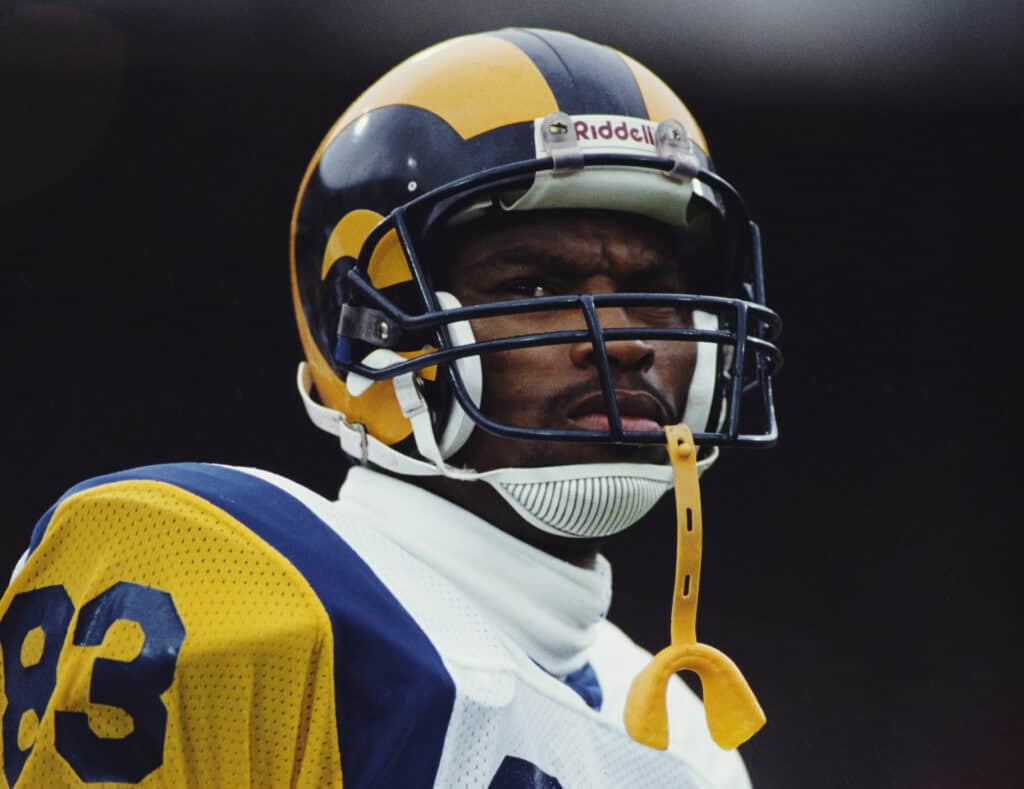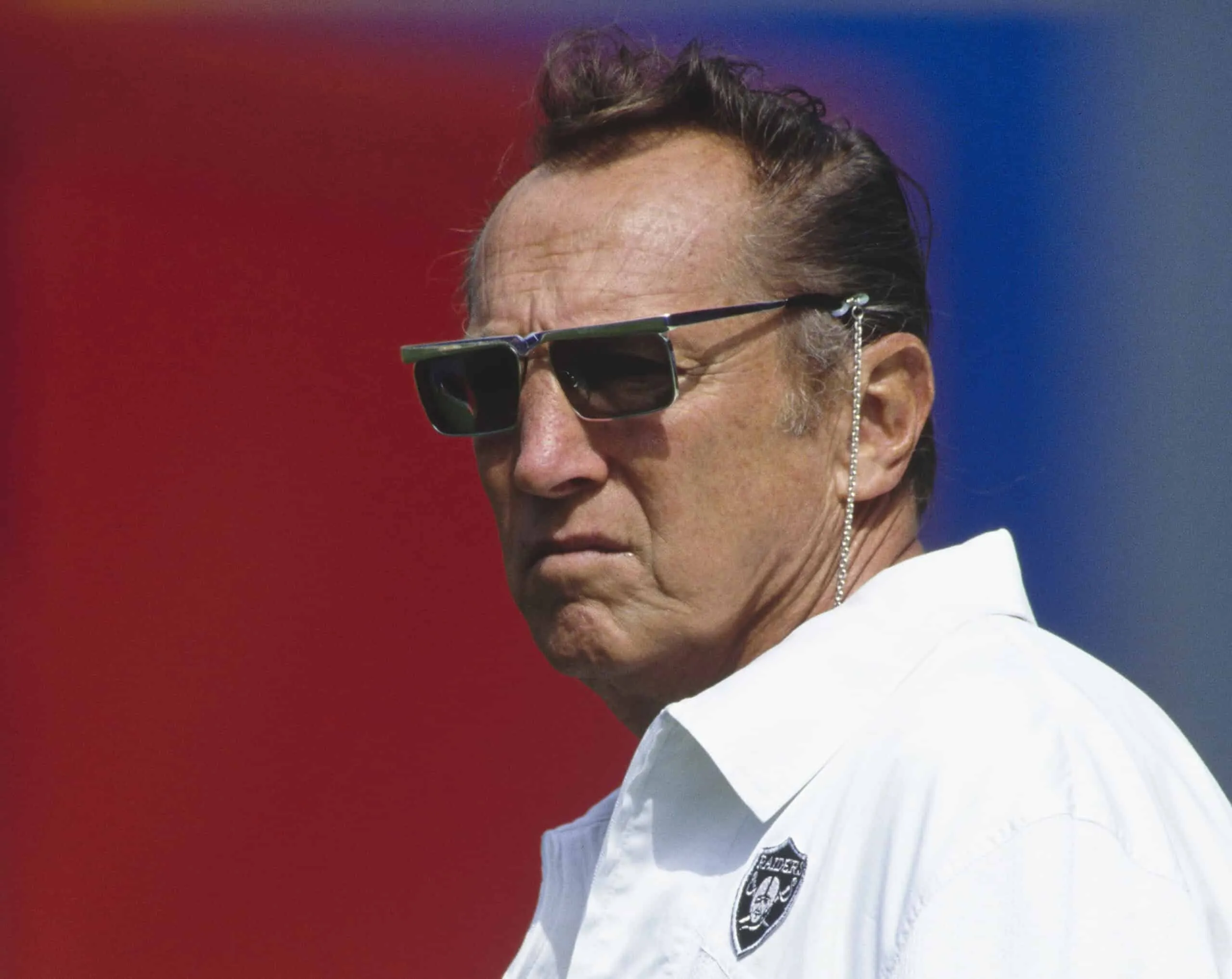
“Just win, baby!”
Late Oakland/Los Angeles Raiders owner Al Davis uttered those words as a rallying cry to his troops.
After coaching the franchise for three years in the mid-1960s, Davis took part ownership soon after.
His mantra would lead the Raiders to three world titles in five Super Bowl appearances while also relocating the organization from Oakland to LA and back to Oakland.
Remembering the great Al Davis today and every day. pic.twitter.com/p0ZxKNRNYY
— Las Vegas Raiders (@Raiders) July 4, 2025
Ever cantankerous and contrary, Davis was unconventional in selecting the players he drafted and signed and thumbed his nose at the ruling class of the NFL.
Although his methods may have largely landed with a thud in his later years, Davis’s leadership is still lauded by former coaches, players and league historians.
This is the story of Al Davis.
Making His Way in Brooklyn
Allan (“Al”) Davis was born on July 4, 1929, in Brockton, Massachusetts.
Today would’ve been Al Davis’ 96th birthday. We continue to keep his spirit alive 🩶🖤 pic.twitter.com/5Rpsze9T0f
— Las Vegas Raiders (@Raiders) July 4, 2025
When he was five, the Davis family moved to Brooklyn, New York.
Almost immediately, young Al adopted the mannerisms, dialect and attitude of the city that would carry him the rest of his life.
He was slight in stature and not the most athletic, but Davis had a chip on his shoulder and ran his mouth with the best of them.
“Al Davis,” recalled Lawrence Kallenberg, a Brooklyn contemporary from a rival school, “made you notice him.”
While Davis’s father made a name for himself in the business world, Al played at nearby Lincoln Terrace Park, a place where only the strong survive.
Years later, Davis would share stories of his time at the park with boxer Mike Tyson, himself no stranger to the area.
After speaking at boxer Sugar Ray Robinson’s funeral in 1989, Davis bragged to Tyson.
“Mike, I played in Lincoln Terrace Park, and I tell you what, it was tough,” He [Tyson] said, ‘What do you mean you played there?’ I said, ‘I played there every day, day and night, unless I went to practice, baseball, basketball and football.’ And I said, ‘I owned that park, Mike,”’ recalled Davis.
Impressed by the little guy’s moxie, Tyson turned to his promoter, the infamous Don King.
“This guy is an S.O.B.,” Tyson said to King. “He’s a tough S.O.B. If he can come out alive of that park, he must be a tough S.O.B.”
Athletic Dreams
Following middle school, Davis attended Erasmus High School, one of the largest public high schools in the nation at the time.
His plan was to play basketball for head coach Al Badain, but his lack of coordination, skinny frame and shaky skills meant he would mostly ride the pine.
A birthday memoriam for #Raiders AL DAVIS, July 4, 1929 – October 8, 2011. 🏴☠️🕶️🖤🙏🏻
The only person to have served pro football in varied capacities as a player personnel assistant, an assistant coach, a head coach, a general manager, a league commissioner and a principal owner. pic.twitter.com/AzGwSmWcZH— AFL Godfather 👓🏴☠️🔥 (@NFLMAVERICK) July 4, 2019
Although Davis wasn’t a sports star, he made plans to spend his life in athletics.
Several of Davis’s Erasmus friends played for the school and would later play professional sports.
That connection, and the fact that he was developing a love of coaching strategy, propelled Davis toward a future on the sidelines.
He graduated as one of the most popular kids in his class at Erasmus and matriculated to Wittenberg College in Springfield, Ohio in the spring of 1947 when he was only 17.
Davis planned on playing baseball for the school and then transferring to a larger school after establishing himself.
Syracuse
His plan lasted all of one semester, and Davis transferred to Syracuse University in the fall of 1947.
On paper, he was an English major, but in reality, Davis spent most of his time studiously trying to make one of the college’s sports teams.
He tried out repeatedly for the basketball and baseball teams and only found a spot on the JV baseball team.
Rebuffed from varsity ball, Davis switched his attention to the football team.
In 1949, Ben Schwartzwalder became the head coach of the Orangemen.
Tune In to a #WakeUpCall for a Special Presentation LIVE WED, AUG 20, 10:15amET as DT welcomes Murray Johnson who’s played under Ben Schwartzwalder at Syracuse in the mid-60s to speak on Orange then & now: https://t.co/FR56Egu7ZC, https://t.co/2VOk8qI2EM, https://t.co/VuEkH07NQs pic.twitter.com/q2XnryC7Bz
— DT Sports Media (@CallDT) August 20, 2025
Although he didn’t play for the team, Davis was entranced by Schwartzwalder and spent all his free time watching practices and games while taking copious notes.
At one point, the heralded coach grew distrustful of the kid and booted him from practice, believing the undergrad was a spy for a rival school.
Now armed with reams of plays, notes and an offensive philosophy, Davis knew what he wanted to do next.
By the time he graduated from Syracuse, his parents’ business was thriving, and Davis’ mother offered to buy him a minor league baseball team.
Instead of making his way as an owner in small-market baseball, Davis decided to become a football coach.
Paying His Dues
Initially, Davis tried to join the football staff at Hofstra University but was turned down.
He then drove to Adelphi University and introduced himself as “Davis from Syracuse.”
It’s part of Davis lore that he was intentionally vague in his introductions to make potential employers think he was Orangeman great, George Davis.
Today in 1963, Al Davis became the head coach and general manager of the Oakland Raiders. Fun Fact- Al began his coaching career at Adelphi University as a baseball coach as well as the linebacker coach from 1950 to 1951. Adelphi is my Alma Mater. pic.twitter.com/2sQ90S2Rqm
— Howard Prince (@Howodd69) January 18, 2024
After shmoozing with the president of the university, Davis had a job as the freshman football and offensive line coach.
In 1952, Davis was inducted into the U.S. Army, where he avoided going to the Korean War by coaching the base team at Fort Belvoir in Northern Virginia.
While he was compiling an 8-2-1 record, he put together scouting reports about his players and sold the reports to NFL teams.
When his service with the Army was completed in 1954, the Baltimore Colts hired Davis as a scout.
That experience led to a stint with The Citadel as the team’s offensive line coach.
While at the school, Davis coerced his fellow offensive coaches to use “race horse” football, a precursor to the no-huddle offense.
Two years with the Bulldogs led to a three-year gig as the offensive line coach at USC.
Graduating to Pro Ball

In 1960, the American Football League (AFL) began play with eight teams, including the Los Angeles Chargers and the Oakland Raiders.
Sid Gillman, the former head coach of the LA Rams, was named as the new head coach of the Chargers.
Gillman’s offenses were dominated by passing, a stark contrast to the run-heavy NFL.
After getting hired to lead the Chargers, Gillman hired Davis to be his receivers coach.
“Al thinks he’s the smartest guy in football,” Gillman said. “He isn’t. But he is going to be.”
(Another notable figure on the LA staff that season was defensive line coach Chuck Noll).
@NFLMAVERICK 1960 Training Camp for the upstart AFL Los Angeles Chargers…HOF Head Coach Sid Gillman is kneeling in the middle…the back row consists of assistant coaches Al Davis and Chuck Noll 🤩🤯…talk about a LEGENDARY coaching staff that would change Pro Football forever pic.twitter.com/GPo7lOuUKT
— Mike M (@MarvelousMike94) July 29, 2024
Quarterback Jack Kemp led the Chargers to a 10-4 record before losing to the Houston Oilers in the AFL Championship Game.
In 1961, LA returned to the title game after a 12-2 season before losing to the Oilers again.
Meanwhile, Davis was constantly on the hunt for players who could help the Chargers’ offense.
He liked University of Arkansas receiver Lance Alworth for his speed, great hands and ability to leap.
“Bambi” (as Alworth was nicknamed) was originally drafted by the Raiders before getting flipped to the Chargers for a handful of players.
January 1, 1962 … 🏈✍️📜🦌⚡️
After the Sugar Bowl game, Chargers WR Coach AL DAVIS had Arkansas Razorbacks HB Lance Alworth sign on with the AFL Chargers.
The NFL San Francisco 49ers had interest in Lance Alworth. pic.twitter.com/BgvZDCbbVK— AFL Godfather 👓🏴☠️🔥 (@NFLMAVERICK) January 1, 2025
Davis cemented the deal by having Alworth sign his contract under the goalposts after his last game with the Razorbacks.
LA responded by taking a massive step backward with a 4-10 record.
Raiders Hire Davis

As the Chargers were appearing in the first two AFL Championship games, the Oakland Raiders were struggling.
The team’s inaugural season in 1960 produced six wins under head coach Eddie Erdelatz.
Oakland started 1961 with two losses, and Erdelatz was fired and replaced by Marty Feldman, who got two wins from the club by the end of the season.
Feldman began 1962 with an 0-5 record before he was fired and replaced by Red Conkright, and managed all of one win.
Before the 1963 season, Oakland team owner Wayne Valley reached out to Davis and hired him to be the franchise’s head coach and general manager.
On this day 60 years ago, everything changed.
33-year-old Al Davis was announced as Head Coach and General Manager of the Oakland Raiders. pic.twitter.com/Exdh6Zc8Yr
— Las Vegas Raiders (@Raiders) January 19, 2023
Davis accepted and, at 33 years old, became the youngest man in pro football to hold both positions.
“(He) will help create a new image of the Raider operation,” Valley boldly predicted.
Now that he had control over his own team, Davis knew exactly how to mold the organization in his image.
“I had to have certain philosophies that had to become part of what I was to do. We weren’t looking for first downs. We didn’t want to move the chains. We wanted touchdowns. We wanted the big play, the quick strike.”
Davis whipped and spurred his players to play better and rode the arms of quarterbacks Tom Flores and Cotton Davidson to a shocking 10-4 record.
First-year Oakland Raiders coach Al Davis, 1963. pic.twitter.com/jqhEd3tYg8
— Football’s Greatest Moments (@FBGreatMoments) July 29, 2025
The nine-win turnaround is still considered one of the best in league history and led to AFL Coach of the Year honors for Davis.
Davis is Named AFL Commissioner
In 1964, Davis added former LSU legend Billy Cannon to his offense, but the Raiders fell to 5-7.
The following year, he signed former New York Jet quarterback Dick Wood to play quarterback.
His intention was to use all his quarterbacks if needed.
“With injuries and changing defenses, you can’t settle any longer on one quarterback to meet all possibilities,” said Davis. “Besides, how many Johnny Unitases are there?”
Oakland played fairly well and produced an 8-5-1 overall record.
During the offseason that followed, then-AFL commissioner Joe Foss abruptly resigned as the NFL breathed down the league’s neck to compete for good players.
Friday, April 8, 1966
AFL President Ralph Wilson welcomed AL DAVIS as the new American Football League commissioner. He replaced Joe Foss. pic.twitter.com/x1eijCBoyJ
— AFL Godfather 👓🏴☠️🔥 (@NFLMAVERICK) April 8, 2024
Davis had already acquired a strong reputation among his AFL peers and was surprisingly nominated to take over the league despite being only 36 years old.
He almost immediately displayed his take-no-prisoners personality by taking a shot across the bow of the more established NFL.
“Give us about three months to get organized,” he said, “and we’ll drop a bomb somewhere.”
Sure enough, AFL teams got aggressive and tried to sign players away from their NFL clubs.
Quarterback stalwarts John Brodie and Roman Gabriel were nearly poached by the AFL, but both ultimately remained in the NFL.
Davis Buys a Stake in the Raiders

Little did Davis know that there were some secret negotiations afoot.
Tex Schramm of the NFL’s Dallas Cowboys met quietly with Kansas City Chiefs owner Lamar Hunt of the AFL.
In the summer of 1966, both leagues merged and came under the banner of the NFL.
Pete Rozelle, who had been the NFL’s commissioner, remained the top dog of the updated, expanded league, leaving Davis without a position after only eight weeks on the job.
August 11, 1966 ✍️🏼
Former AFL commissioner AL DAVIS rejoined the Oakland Raiders. General partners Wayne Valley and Ed McGah admitted AD into their general partnership. pic.twitter.com/eHiY4aS4HZ
— AFL Godfather 👓🏴☠️🔥 (@NFLMAVERICK) August 11, 2025
He pivoted and spent $18,500 to purchase a 10% stake of the Raiders and was named their managing general partner.
Oakland went 8-5-1 in ‘66, then went 13-1 in 1967 and won the AFL Championship against Houston before falling to the Green Bay Packers in Super Bowl II under head coach John Rauch.
The Raiders took a 12-2 record into the 1968 playoffs and blew out the Chiefs in the divisional round before falling to the New York Jets in the AFC Championship.
Madden Comes Aboard
Although Davis was part of the ownership group of the Raiders, he couldn’t help but meddle with the play calling of his coaches.
Rauch had gotten the team to Super Bowl II in 1967 and to the AFC Championship game a year later.
However, Davis’s constant interference grated on the coach, and he resigned after the 1968 season.
The owner then promoted Oakland’s linebacker coach, John Madden (who was 32 years old at the time), to the head position.
Al Davis
John Madden#Raiders pic.twitter.com/lYPWkIviFa— Old Time Football 🏈 (@Ol_TimeFootball) April 10, 2023
Thankfully, Madden was already deeply entrenched in the culture of the Raiders, so he was used to Davis’s “feedback.”
It also helped that he was a player’s-coach who allowed his somewhat colorful athletes to be themselves.
By the time Madden took over, the Raiders already had a collection of notable players.
They included George Blanda, Daryle Lamonica, Fred Bileitnikoff, Jim Otto, Art Shell, Gene Upshaw, Ben Davidson, George Atkinson and Willie Brown.
In 1969, the Raiders lost one game in the regular season before losing to Kansas City in the AFL title game.
After an 8-4-2 record in 1970, Oakland advanced to the AFC Championship Game before losing to the Baltimore Colts.
Trailblazer
Having grown up in a culturally diverse area of New York City, Davis was well aware that athletic talent came in all colors.
Therefore, he wasn’t afraid of bringing in players from historically Black colleges, athletes that some franchises wouldn’t touch.
When the Raiders traveled to the South in the 1960s, he would steer the team away from hotels that would not allow his Black and white players to stay at the same place.
A number of cities in the South invited Davis and his team to play in their town, but Davis would say no if he found out that the city segregated its population.
Alphonse Dotson, 82, was great talking about the greatest QB in PVIL history, Eldridge Dickey, a teammate for 3 years at Oakland. Dickey, a Houston native, was the first Black QB to be drafted in the first round (1968), but Al Davis moved him to WR. He never played QB in the NFL. pic.twitter.com/pChFUVEF5D
— John McClain (@McClain_on_NFL) July 24, 2025
In 1968, the owner drafted Tennessee State quarterback Eldridge Dickey in the first round of the AFL Draft.
That was the first time a Black quarterback had been taken in the first round of the event.
He was then moved to receiver as Ken Stabler was drafted the same year and placed in the quarterback room.
“Looking back now, gosh, that was a huge step for Al Davis. I could see he was seeing beyond complexion,” Dickey said in 2000.
“Just Win, Baby”
No matter what, Davis expected the Raiders to consistently contend for championships, and after acquiring more control of the team from Wayne Valley in 1976, he pushed hard for the best results.
As he built the roster, Madden coached the team well, despite just missing the chance to play for a world title.
In 1973, 1974 and 1975, Oakland lost in the AFC Championship each year.
The ‘74 and ‘75 teams lost to the Pittsburgh Steelers, and the Steelers also broke the Raiders’ hearts in 1972 during the “Immaculate Reception” contest in the divisional round.
Despite coming up short, Davis continued to implore his “Just win, baby” slogan to the players and coaches.
The origin of ‘Just Win, Baby’ pic.twitter.com/Y8JtfQnAQg
— The Al Davis Memorial (@AlDavisMemorial) August 7, 2025
Finally, in 1976, the team caught fire.
Now armed with the additions of Cliff Branch, Dave Casper, Jack “The Assassin” Tatum and Skip “Dr. Death” Thomas, Oakland went 13-1 and advanced to its second Super Bowl.
Facing the Minnesota Vikings and their “Purple People Eaters” defense, the Raiders destroyed Minnesota, 32-14.
#OTD in 1977: The Oakland @Raiders made history with their first Super Bowl win! 🏆
In Super Bowl XI, the Raiders defeated the Vikings (32-14) with a team meticulously built by Owner Al Davis and led by legendary coach John Madden. This iconic roster included seven future Hall… pic.twitter.com/oi7JyqAQwh
— Pro Football Hall of Fame (@ProFootballHOF) January 9, 2025
An 11-3 record in 1977 led to a loss against Denver in the AFC Championship.
Then, citing burnout, Madden decided to step down as coach after Oakland failed to make the playoffs in 1978 despite a 9-7 record.
An Island of Misfit Toys
Following Madden’s departure, Davis promoted his receivers coach, Tom Flores, to lead the team.
Flores had previously been a player with the Raiders and Chiefs.
He was the first Mexican-American to win a Super Bowl in league history when he was on the Kansas City roster in 1969 for Super Bowl IV.
With the passing of Raider Legend Jim Otto…at least 7 members of the original 1960 team have passed since 2020!!
QB Tom Flores (pictured here w/Al Davis) is one of the few remaining survivors from that inaugural squad.
We must remember to celebrate the men who paved the way pic.twitter.com/3tVuDTUb5M— Raider66 (@R8r66) May 21, 2024
Oakland repeated with a 9-7 record in 1979, then geared up for a championship run in 1980.
Davis was adept at finding players who were cast aside by other teams and giving them a second chance with the Raiders.
“He could always spot players who were undervalued,” said former NFL executive Frank Hawkins. “He was Billy Beane before Billy Beane.”
In 1980, the organization’s starting quarterback was Jim Plunkett, who had been the first overall pick of New England in 1971 before getting traded to San Francisco in 1976.
#Raiders QB Jim Plunkett with AL DAVIS. 🏴☠️🏈 pic.twitter.com/UlJ0b0qqdc
— AFL Godfather 👓🏴☠️🔥 (@NFLMAVERICK) May 24, 2019
A few lackluster seasons with the Niners had Plunkett’s NFL future on life support before Davis brought him on board in ‘80.
Also on the roster was John Matuszak, a player who had washed out with four teams before landing in Oakland in 1976.
Super Bowl XV trophy presentation by Commissioner Rozelle to AL DAVIS with NBC's Bryant Gumbel.
Al LoCasale and Tom Flores flanked AD. His security man Carlton Henry Ivey behind AD. pic.twitter.com/ZizJWEiVgu
— AFL Godfather 👓🏴☠️🔥 (@NFLMAVERICK) January 25, 2024
The Raiders won 11 games, beat Houston, Cleveland and San Diego in the playoffs before taking down the Philadelphia Eagles in Super Bowl XV.
Davis Moves the Team to LA
Not even two years later, Davis broke the hearts of Oakland fans when he moved the franchise to Los Angeles before the 1982 season.
He had previously asked the city to make improvements to the Oakland-Alameda Coliseum, where the team played.
When the city balked, Davis threatened to move the Raiders to LA, but Commissioner Rozelle and the other team owners refused.
Today In History 1982 Raiders move to Los Angeles
After 2-yrs lawsuits, team owner Al Davis is allowed to move the Raiders from Oakland to LA. The Raiders will play there until 1995 when they will move back to Oakland. In 2017, then announcing plans to relocate to Las Vegas. pic.twitter.com/YQnLEI2z1f— Judy Fulbright (@JudyFulbright5) May 7, 2025
The owner then sued the NFL and was awarded $35 million in damages ($18 million in a settlement) by a jury in an antitrust suit.
That cleared the path for the organization to become the Los Angeles Raiders.
Another Super Bowl for Davis

In his first year in the City of Angels, Davis signed former Browns bad-boy Lyle Alzado and drafted USC running back Marcus Allen.
Both players were honored by the NFL as the Offensive Rookie of the Year (Allen) and Comeback Player of the Year (Alzado) following an 8-1, strike-shortened NFL season.
The Raiders lost in the Second Round of the playoffs to the New York Jets, but returned to the postseason in 1983 after winning 12 games.
Plunkett and Allen paced the offense while youngsters Howie Long and Greg Townsend (a rookie) led a voracious defense.
AL DAVIS 🏴☠️👓
Super Bowl XVIII postgame victory speech pic.twitter.com/jIpQYxfeBE— AFL Godfather 👓🏴☠️🔥 (@NFLMAVERICK) January 22, 2023
Victories against Pittsburgh and Seattle led to another championship game appearance for the franchise.
Davis’s bunch secured its second title in four years after a thorough 38-9 victory over the Washington Redskins in Super Bowl XVIII.
Davis Hires Art Shell
In 1984 and 1985, the Raiders won 11 and 12 games, respectively, and Allen received the NFL’s MVP award in ‘85 after rushing for over 1,700 yards.
Although the running back was already one of the best in the game, Davis didn’t much care for him.
“Al is upset because Marcus can’t run fast enough…. Of all the silly damn things,” said a team executive. “Marcus will be in the Hall of Fame and Al will say, ‘Yeah, but he could only run 4.7 [in the 40-yard dash].'”
Despite the number of wins, the franchise lost early in the playoffs both years.
Then, 13 combined victories in 1986 and 1987 led to Flores moving to the front office.
1988: Al Davis introduces Mike Shanahan as HC. From 1963-87, the #Raiders had just 4 head coaches.
Since this day in 88, the team has had 19 head coaches. #RaiderNation pic.twitter.com/8AfRxM8YSE
— Raiders History (@Oaklraiders1976) March 9, 2025
Denver Broncos offensive coordinator Mike Shanahan was hired by Davis to replace him in 1988.
The pressure was on the new coach to transform an offense that not only had Allen but fellow running back Bo Jackson, who was drafted the year before.
#Raiders 1987 draft 7th rounder (183 overall) Bo Jackson pic.twitter.com/O9SWgHEddN
— AFL Godfather 👓🏴☠️🔥 (@NFLMAVERICK) April 20, 2018
Davis and Jackson connected when the owner told the multi-sport star that he could play both professional baseball and football.
That season, the Raiders also included rookie Tim Brown, Willie Gault, James Lofton and “Swervin’” Mervin Fernandez at receiver.
However, under Shanahan, the offense barely improved from 17th overall in Flores’s final year to 16th in ‘88.
October 9, 1989
For the first time in modern NFL history, a Black man is head coach in an NFL game as Art Shell leads the #Raiders to a 14-7 victory over the Jets on Monday Night Football at the Meadowlands.
Shell becomes the NFL's first Black head coach since Fritz Pollard… pic.twitter.com/sd7DhA40Kp
— Kevin Gallagher (@KevG163) October 9, 2023
LA went 7-9 then 8-8 in 1989 when Shanahan was fired after a 1-3 start and replaced by interim coach Art Shell, a former Raiders lineman.
When the Raiders responded with a 7-5 finish to the season, Davis anointed Shell as the head coach in 1990.
That made Shell the first Black head coach in the NFL’s modern era and the first NFL Black head coach since Fritz Pollard in 1925.
Back to Oakland
The Raiders did well with their new coach.
Although the offense dipped to 18th overall in 1990, LA went 12-4 and advanced to the AFC Championship before getting waxed, 51-3, by the Buffalo Bills.
A playoff appearance in 1991, followed by a 7-9 season in 1992 (the same year Davis was inducted into the Pro Football Hall of Fame and presented by John Madden), led to a 10-6 record in 1993.
August 1, 1992
AL DAVIS was enshrined into the Pro Football Hall of Fame.
John Madden was his presenter. pic.twitter.com/21ZN9jDklA
— AFL Godfather 👓🏴☠️🔥 (@NFLMAVERICK) August 1, 2023
LA advanced to the divisional round before losing to the Bills once again.
After a 9-7 season in 1994, Shell was fired, and Davis decided to leave Los Angeles.
The owner had long pressed the city to update and renovate the LA Coliseum, where the Raiders played.
On June 23, 1995, Al Davis signed a letter of intent to move the Raiders back to Oakland after 13 seasons in Los Angeles 🏴☠️
30 for 30: Straight Outta L.A. 🎥 pic.twitter.com/QyT3s51vuh
— NFL on ESPN (@ESPNNFL) June 23, 2025
However, progress toward the renovations didn’t happen fast enough, and Davis took the franchise and returned to Oakland.
The relocation was approved by the NFL owners by a single vote, thereby avoiding yet another in a long line of lawsuits initiated by Davis.
“Personally, I was fond of him,” said Cincinnati Bengals owner and president Mike Brown. “He battled with the NFL, and a lot of us wished that had not been where things went, but under all that was a person I respected.”
One Last Super Bowl Run

The Raiders returned to Oakland with much fanfare, then had three losing seasons in a row under coaches Mike White (1995 and 1996) and Joe Bugel (1997).
In 1998, Davis hired former Philadelphia Eagles offensive coordinator Jon Gruden as his new head coach.
August 29, 1998
AL DAVIS with rookie HC Jon Gruden at the Cardinals versus #Raiders preseason game. pic.twitter.com/8skI3rnq0C
— AFL Godfather 👓🏴☠️🔥 (@NFLMAVERICK) August 29, 2020
Oakland responded with consecutive 8-8 seasons in ‘98 and 1999 before going 12-4 in 2000.
Armed with rejuvenated QB Rich Gannon, the Raiders shut out the Miami Dolphins in the divisional round before succumbing to the Baltimore Ravens in the AFC Championship.
One year later, Oakland went to the divisional round of the playoffs before losing to the New England Patriots, 16-13, in overtime.
Then, in a power move by Davis, the owner traded Gruden to the Tampa Bay Buccaneers for a bevy of draft picks and a pile of money.
“I never liked it when teams would interfere with coaches under contract…Tampa Bay came to me and they said they wanted Gruden…I felt that I put the price tag so high that they wouldn’t agree to it. And they did. Gruden is no longer our coach,” Davis said at the time.
Bill Callahan, the team’s offensive coordinator and offensive line coach, was promoted by Davis in 2002.
That season, the organization went 11-5 with Gannon throwing footballs to former San Francisco receiving legend Jerry Rice.
Oakland beat the Jets and Titans in the postseason before facing Gruden and Tampa Bay in Super Bowl XXXVII.
Super Bowl XXXVII
January 26, 2003The #Buccaneers set a #SuperBowl record with five interceptions — including an #NFL postseason record-tying three pick-sixes — in their 48-21 triumph over the Raiders.
The #Bucs' first Super Bowl title pic.twitter.com/q5FASBWLnQ
— Kevin Gallagher (@KevG163) January 26, 2024
Regrettably, for the Raiders and their fans, Callahan hadn’t changed the offense much since Gruden’s departure.
“Chucky” took advantage of that mistake by leading his new team to a relatively easy 48-21 victory over his old boss.
Hard Times
Sadly, for Davis, 2002 would be the last time his beloved Raiders would advance to a Super Bowl (or the playoffs, for that matter) in his lifetime.
For the next decade, the franchise suffered defeats both on the field as well as in the draft.
Callahan was fired after four wins in 2003, and Norv Turner was fired after two losing seasons in 2004 and 2005.
Al Davis and Bill Walsh
Legends and old friends#Raiders–#49ers, August 2002 pic.twitter.com/9pG5fpRg1a
— Kevin Gallagher (@KevG163) August 16, 2025
Shell returned in 2006, but was canned after one year, leading to a rift between Davis and his former player, although Shell later gave his former boss all due respect.
“I could not have gotten to where I got without him. He gave me an opportunity to be a player; he gave me an opportunity to be an assistant coach, head football coach, and to coach that football team twice,” said Shell.
Lane Kiffin was given a season and a quarter as head coach, but was ultimately dismissed by Davis after four games in 2008.
Tom Cable had almost three years as the Raiders’ head coach and was fired after the 2010 season.
(Cable’s 8-8 record in ‘10 was the best by a Raiders head coach since Callahan’s 2002 season).
Davis also struggled with the draft, an event where he used to thrive.
JaMarcus Russell was a talented quarterback at LSU who was drafted by Davis in the first round of the 2007 draft.
This Date, 13 Years Ago: Raiders take Jamarcus Russell with the first pick. Made $39 million, or $1.56 million per career start. pic.twitter.com/lcoffraCq4
— Darren Rovell (@darrenrovell) April 28, 2020
He instead became one of the biggest busts in league history and was out of football by 2010.
Darrius Hayward-Bey ran the 40-yard dash in 4.3 seconds, and Davis, who always loved speedy players, took the Maryland receiver in the first round of the 2009 draft.
The pass-catcher didn’t quite pan out and caught just 140 passes for 11 touchdowns in four seasons with the team.
Davis Passes Away

While the Raiders were struggling to maintain their mystique, Davis’s health was failing.
He had always been well aware of death (having watched his wife, Carol, recover from a serious heart attack in 1979) and worked to confront it.
“Disease is the one thing — boy I tell you, it’s tough to lick,” he said in 2008, talking about the leg ailments that had restricted him to using a walker. “It’s tough to lick those diseases. I don’t know why they can’t. I can control most things, but I don’t seem to be able to control death.”
By the time he was in his early 80s, Davis’s health was affected by skin cancer and a failing heart.
Remembering Al Davis, the legendary heart of the Raiders. His passion, vision, and commitment to excellence built a legacy that lives on in every silver and black moment. Forever a Raider. #RaiderNation pic.twitter.com/KPMc5qXYwx
— Jimmy James aka Raider Duke (@LaJeunesseArt) July 4, 2025
On October 11, 2011, he passed away from heart complications at the age of 82.
“He was ahead of his time in many, many, many regards,” said Amy Trask, the first female chief executive in pro football whom Davis hired in 1983. “He hired people—and, yeah, fired and cussed at people—without regard to race, gender, religion, ethnicity or any of these individualities.”
Despite his decline in the years prior to his death, most in the NFL world remembered Davis for his numerous contributions to the game.
“Al Davis’s passion for football and his influence on the game were extraordinary,” Commissioner Roger Goodell said. “He defined the Raiders and contributed to pro football at every level. The respect he commanded was evident in the way that people listened carefully every time he spoke. He is a true legend of the game whose impact and legacy will forever be part of the NFL.”
After his passing, Davis’s only child, Mark, took over as managing general partner of the franchise.
In true Davis fashion, Mark moved the franchise for a third time, to Las Vegas, in 2020.
References
https://www.pro-football-reference.com
https://www.profootballhof.com/players/al-davis/
https://www.profootballhof.com
https://www.profootballhof.com
https://www.theeagleonline.com
https://www.raiders.com/history/al-davis
NEXT: The Life And Career Of Sebastian Janikowski (Story)