Flag football will make its Olympic debut during the 2028 Summer Games in Los Angeles.
Just like they have in hockey and basketball, pro athletes are vying for the few coveted spots on the official U.S. team roster.
In a March 2026 exhibition, several current and former NFL players competed against Team USA members who specialize only in flag football.
As expected, the pros figured to mop up the underdog joes.
Team USA got the last laugh when they thoroughly embarrassed the pro teams by a combined score of 82-27 over four games.
Although participating in the Olympics might be a feat that professional athletes would love to achieve, they should be cautious.
Sustaining a career-ending injury is an acknowledged risk for NFL athletes and coaches.
However, sustaining such an injury away from the field would be catastrophic.
Just ask Robert Edwards.
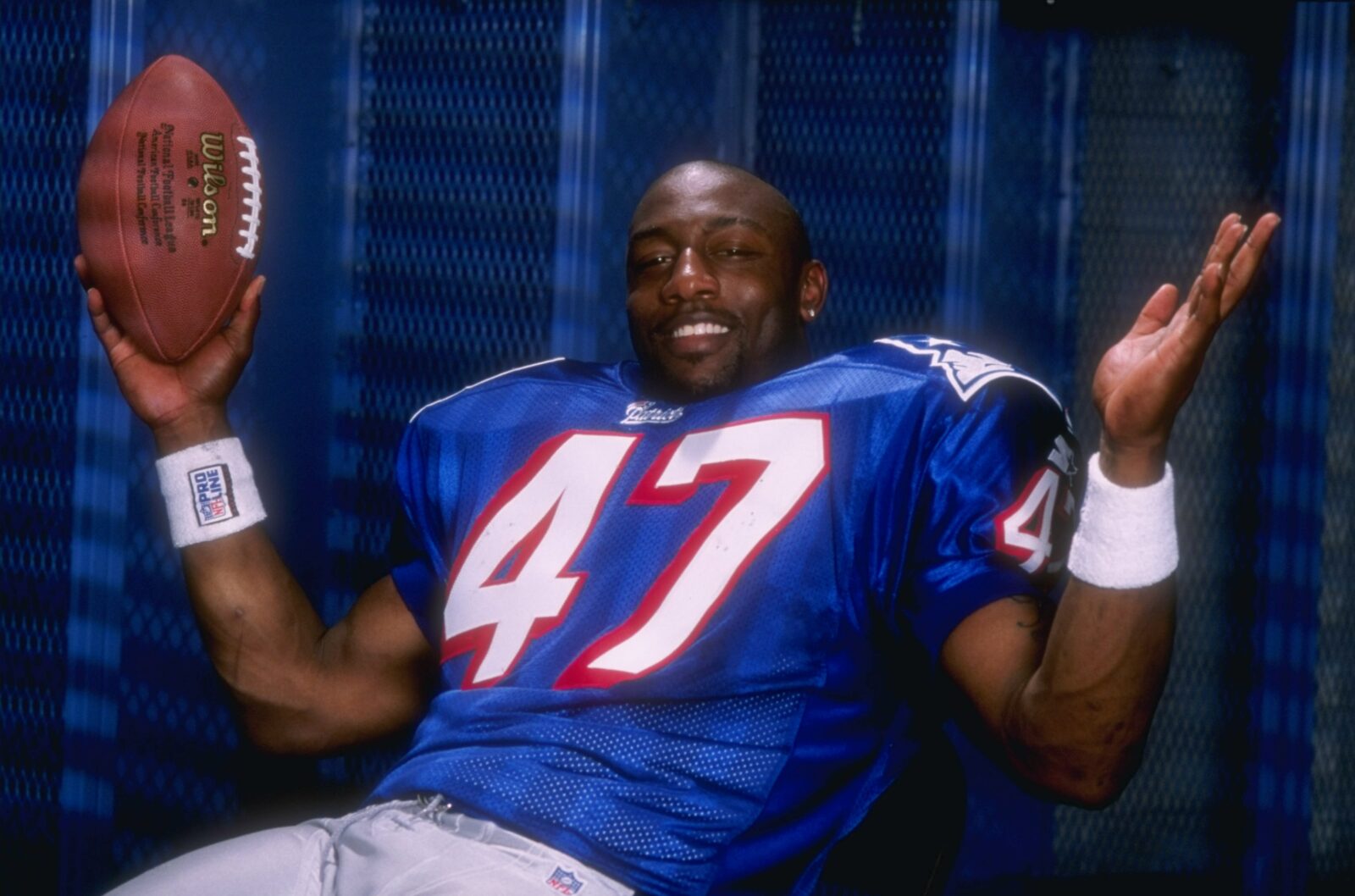
The Patriots drafted Robert Edwards in the 1st round (18th overall) of the 1998 NFL Draft.
Rookie year:⁰1,115 rushing yards⁰331 receiving yards⁰9 TDs
Then came the devastating Pro Bowl injury.
You can’t help but wonder what his career could’ve become. pic.twitter.com/8G76NhTKzy
— Foxboro Forever (@_FoxboroForever) March 21, 2026
In 1998, Edwards rushed for over 1,100 yards as a rookie for the New England Patriots.
After the season, he was invited to play in an NFL rookie flag football game in Hawaii during Pro Bowl week.
During the game, Edwards landed awkwardly and injured his knee so severely that his lower leg was nearly amputated.
Because of the long rehab process, Edwards didn’t play again until he was a member of the Miami Dolphins in 2002.
Following four seasons in the CFL, Edwards retired and became a high school football coach.
This is the story of Robert Edwards.
Long Shot in Georgia
Robert Lee Edwards III was born on October 2, 1974, in Tennille, Georgia.
Happy 45th bday Robert Edwards! After being drafted 18th overall by the Patriots, he ran for 1115 yards & 9 TDs & caught 35 passes & 3 more TDs as a rookie. He then suffered serious injury during beach flag football. Missed 3 years. Came back w/Dolphins & scored 2 Tds in 1st game pic.twitter.com/1saIANGMbA
— Scott F (@TheFrizz87) October 3, 2019
Shortly after his birth, Edwards’ future playing sports looked bleak at best.
He was born with underdeveloped muscles in both his legs that caused him to wear braces (much like Tom Hanks’ character early in the movie Forrest Gump).
Thankfully, just like young Forrest, Edwards overcame his handicap and busted loose from his braces by the time he reached high school.
When he attended Washington County High School in Sandersville, Georgia, he was a force to be reckoned with.
Edwards suited up for the Golden Hawks and played on both sides of the ball, primarily as a defensive back.
During his senior year, Washington County went 14-1 with the only loss coming at the hands of Mitchell-Baker High School in the 1992 state championship game.
Although Edwards was clearly a good DB, as evidenced by receiving the Georgia Defensive Player of the Year Award, he wasn’t heavily recruited by colleges until late in the season.
A late-arriving SAT score made college programs pause until they could see if he would be academically eligible to play.
A Bulldog

Edwards’ test score was good enough that the Florida Gators and Georgia Bulldogs came calling.
After his visit with the Gators didn’t pan out, Edwards committed to stay in-state with the Bulldogs.
Head coach Ray Goff kept Edwards in the secondary, where he appeared in 11 games in 1994 (after missing 1993 with a broken hand), and had four interceptions for 30 return yards.
Robert Edwards originally came to Georgia as a DB before moving to RB and being selected in the 1st round of the NFL Draft by the New England Patriots.#GoDawgs https://t.co/JuzNNBi3dF
— The Bulldawg Report (@ReportBulldawg) January 24, 2024
Then, before his sophomore year in 1995, the coaching staff moved Edwards to the offensive side of the ball and started him at running back.
It was a wise decision.
In the first game of the season against South Carolina, the 5’11”, 218-pound Edwards went off, scoring no less than five touchdowns (a Georgia single-game record) in a landslide 42-23 victory.
A week later, against the Tennessee Volunteers, Edwards broke a bone in his foot and was sidelined the rest of the year.
“I’d gained instant fame at running back. It was overwhelming and overpowering. Fame makes you forget who you really are. My broken foot [in college] led me back to myself,” said Edwards in 1999.
He ended the season with 325 rushing yards and seven combined touchdowns.
Highs and Lows
The Georgia team reconvened for the 1996 season with Jim Donnan as its new head coach.
Both sides of the ball had solid athletes, including quarterback Mike Bobo, Edwards, Hines Ward at receiver, Champ Bailey at cornerback and future Bulldogs head coach Kirby Smart at safety.
That season, UGA went 5-6, but Edwards saw the field for all 11 games and rushed for 800 yards and nine touchdowns, along with 23 receptions for 199 yards and another score.
Just when the running back was hitting his stride, he was sidelined again when he sprained his ankle on the first carry of the 1997 season.
After missing parts of three games because of the injury, Edwards returned with a vengeance.
27 years ago today on 11/1/1997, #Georgia (a 20.5-point underdog) intercepts 4 passes, including 2 by Kirby Smart, and Robert Edwards scores 4 TDs in a 37-17 upset over Florida.
According to the spread, it remains the Bulldogs’ biggest upset win since the 1940s @ugasportscom pic.twitter.com/HnFOVHSWnQ
— Patrick Garbin (@patrickgarbin) November 1, 2024
On November 1, the Bulldogs traveled to The Swamp and met coach Steve Spurrier and the Florida Gators.
Spurrier could only look on with disbelief as Edwards tore through the Gators’ defense with 127 yards and four touchdowns in a resounding 37-17 win.
Finishing Strong
Following a loss to Auburn a week later, Georgia didn’t lose again that season.
A 9-2 record got the Bulldogs a date with the Wisconsin Badgers in the Outback Bowl.
During the contest, Edwards had a relatively easy day with 110 yards and three touchdowns in a 33-6 victory.
That season, he ran for 908 yards and 12 touchdowns (both career-highs), caught 23 passes for 214 yards (career-high) and a touchdown, and even returned two kicks for 12 yards.
BREAKING: Former Georgia running back Robert Edwards is returning to the program in a support staff role after 17 years coaching at the high school level…https://t.co/uExj36mZtV pic.twitter.com/lV8Wj0kHTO
— DawgsHQ (@DawgsHQ) February 16, 2026
For his efforts, Edwards was named a second-team All-SEC member.
In his four seasons as a Bulldog, Edwards rushed for 2,033 yards and 27 touchdowns, caught 48 passes for 455 yards and three touchdowns, intercepted four passes, and returned four kicks for 39 yards.
Years later, he would be added to the Florida-Georgia Hall of Fame.
Great Rookie Year

Following a 1997 season in which he rushed for 1,160 yards, New England Patriots running back Curtis Martin became a free agent and signed with the New York Jets.
His departure meant the Pats needed a new back to carry the rushing load.
Although he had missed several games in college because of injuries, Martin was selected by New England with the 18th overall pick in the 1998 NFL Draft.
Two years earlier, the franchise advanced all the way to Super Bowl XXXI under head coach Bill Parcells, but lost to the Green Bay Packers, 35-21.
Parcells left weeks after the Super Bowl and was replaced by Pete Carroll, who got the Pats to the divisional round in 1997 before losing to Pittsburgh.
In 1998, the organization still had a good offensive roster with QB Drew Bledsoe, tight end Ben Coates, and receivers Troy Brown and Shawn Jefferson.
Robert Edwards #Patriots #NFL pic.twitter.com/eZ2Lk5na6J
— kelly Hammond (@kellyHammo71824) October 16, 2024
During his rookie year, Edwards did much better than expected and played in all 16 games while starting 15.
He rushed for 1,115 yards, nine touchdowns, and caught 35 passes for 331 yards and three more scores as New England went 9-7 and lost to Jacksonville in the wild-card round.
#Throwback On this day in #NEPats History.
Kansas City #Chiefs at New England #Patriots – October 11th, 1998
Rookie RB Robert Edwards scores his 5 rushing TD in his first 5 games. pic.twitter.com/jv0pZ6Gk5O
— RetroPatriots (@RetroPatriots) October 11, 2024
Better yet, he set a record with six consecutive games with a touchdown (five rushing, one receiving) to begin his career.
After the season ended, Edwards was named to the PFWA All-Rookie Team.
Additionally, he was invited to take part in a rookie flag football game during the Pro Bowl week in Hawaii.
Heartbreak
The event was called the “Rookie Beach Bowl,” a 4-on-4 game, and many of the NFL’s top rookies were invited, including Charles Woodson, Peyton Manning and R.W. McQuarters.
After assembling on Waikiki Beach on the south shore of Honolulu, the athletes began playing while laughing and lightly trash-talking each other.
Then-Detroit Lions QB Charlie Batch tossed a pass in the direction of McQuarters, a receiver for San Francisco.
Woodson and Edwards were playing defense, and both jumped to defend the pass.
All three then crumbled to the sand.
McQuarters and Woodson got up, but Edwards stayed down, clutching his left knee.
Former first round pick Robert Edwards was told he would never walk again after suffering a gruesome knee injury at his first ever NFL Pro Bowl. Not only did he walk again, he ran… for 2 TDs in his first game back in the NFL. pic.twitter.com/h5A5mZZBCn
— UGA Savage Pads (@savagepads) October 16, 2019
Initially, he didn’t feel a lot of pain, although he knew something was very wrong as he was carried from the beach into a waiting ambulance.
While being transported to a nearby hospital, the pain hit like a tidal wave.
It was at that moment that Edwards realized he needed to see a doctor immediately.
“It felt like we weren’t ever going to get to the hospital,” Edwards said. “First, it took a while to get me into an ambulance, and then they stopped at every red light. I kept yelling, ‘Turn on the siren!'”
Finally, he was x-rayed and consulted by a doctor who told him the grim news.
Edwards had torn the MCL, PCL, and ACL in his knee and partially torn his LCL.
Additionally, a major artery had been severed that supplied blood flow to the lower part of his leg.
If the doctors couldn’t restore blood flow, the running back would have that part of his leg amputated.
The Road Back
The surgeon who operated on Edwards, Dean Soto, was shocked by what he saw.
“It looked,” said Dr. Soto a few years later, “like someone just threw a hand grenade in there. It was a devastating injury. At that point, I was much more concerned with saving his leg than his football career. We figured, ‘Well, he might be able to walk with a cane someday.’ That was the upside.”
Thankfully, Soto was able to save the leg, but Edwards had a long road ahead of him just to be able to stand and walk again.
“I thought to myself, ‘Why? Why?’ ” Edwards recalled. “I went through the whole season without getting hurt, then I’m playing a game that’s supposed to be fun, and this happens.”
After more surgery back in New England, Edwards returned to Georgia and began rehabbing in Athens, not far from the Georgia campus.
He was able to watch his younger brother play for the Bulldogs while working six days each week to teach his leg how to function again.
Because of the injury, Edwards didn’t play in 1999 or 2000, although by then he felt he was ready to come back.
“If it was up to me, I would be playing right now,” said Edwards in a November 2000 interview. “But it is not up to me, I’ve got to get cleared by the doctors. They are going to evaluate me, and I’m sure they are going to do the best thing for me because if I had to make the decision, I probably would play, and that probably wouldn’t be the best thing for me.”
Comeback

Just when it looked like Edwards would return for the Patriots in 2001, he injured his groin in training camp and was once again lost for the year.
Second-year head coach Bill Belichick then made the decision to cut ties with the former first-rounder.
“This in no way detracts from the remarkable accomplishments Robert has achieved through two years of dedication and commitment,” said Belichick. “He has our lasting respect and admiration, and his story will always be an inspiration to everyone. We just reached the point where we ran out of time.”
Instead of feeling discouraged, Edwards kept working out and prepared to play NFL football.
Happy 46th bday Robert Edwards! Scored 30 TD in 3 years at Georgia, drafted 18th by Patriots. Ran for 1115 yards, caught 35 passes & scored 12 TD as a rookie, making Pro Bowl. Tore up knee badly in beach flag football. Made way back with Dolphins 4 years later & had a 2 TD game. pic.twitter.com/e5hJzfrABO
— Scott F (@TheFrizz87) October 2, 2020
Before the 2002 season, Miami Dolphins head coach Dave Wannstedt brought him in for a workout and offered Edwards a $300,000 contract.
“You don’t keep guys on the roster just because they try hard,” Wannstedt said. “You’d have 80-man rosters if that was the case. Nah, he earned it. He told us in the spring he could come back, and he did it.”
He wouldn’t get much playing time behind newly acquired back Ricky Williams, but at long last, Edwards would get an opportunity to play.
As Miami went 9-7 and Williams led the NFL with 1,853 yards and 16 touchdowns, Edwards played in 12 games and gained 107 yards and one touchdown rushing and caught 18 passes for 126 yards and another score.
When the season ended, he was released by the Dolphins.
Playing in the CFL and Retirement

Three years later, Edwards got another opportunity to play pro ball when the Canadian Football League’s Montreal Alouettes signed him in 2005.
Reborn and feeling fully healthy, he rushed for 1,199 yards and eight touchdowns as the team went 10-8 and lost in the Grey Cup to Edmonton.
Daijun Edwards has signed with the Montreal Alouettes.
Robert Edwards and Terrence Edwards also played for the Montreal Alouettes. https://t.co/yZBOy30fWb
— The Bulldawg Report (@ReportBulldawg) March 7, 2025
In 2006, Edwards ran for 1,137 yards and 14 scores while the Alouettes went 10-8 again and lost in the Grey Cup to British Columbia.
Edwards spent time in Montreal in 2007 before getting released and signing with the Toronto Argonauts in August 2007, where he ran for 596 yards and two touchdowns.
Following the season, he retired from professional football.
During his short NFL career, Edwards rushed for 1,222 yards and 10 touchdowns, caught 53 passes for 457 yards and four more touchdowns.
In the CFL, he had 3,022 yards and 25 touchdowns, 55 receptions for 461 yards and three scores.
High School Coach
Having proved himself on the field despite a life-threatening injury, Edwards next proved himself adept at coaching.
Despite not having experience, he was hired as the head football coach at Arlington Christian School in Fairburn, Georgia, in 2010.
The program went 15-7 and won two regional titles in two seasons.
In 2012, he was hired as the new head coach at Greene County High School and spent six years there, producing one winning season in 2016.
Former Georgia RB Robert Edwards is joining UGA support staff. #GoDawgs pic.twitter.com/hY3f76D6qE
— Mike The Mad Dawg (@Mad_Dawg19) February 17, 2026
Next up was Riverwood High School from 2018 through 2021 (32 victories and two region titles) before returning to his alma mater, Washington County High School, to coach in 2022.
In February 2026, Edwards was hired by his former college teammate, Georgia coach Kirby Smart, to work as an analyst for the program.
References
https://www.centralgasports.com
https://www.sports-reference.com
https://www.pro-football-reference.com
NEXT: The Life And Career Of Tony Eason