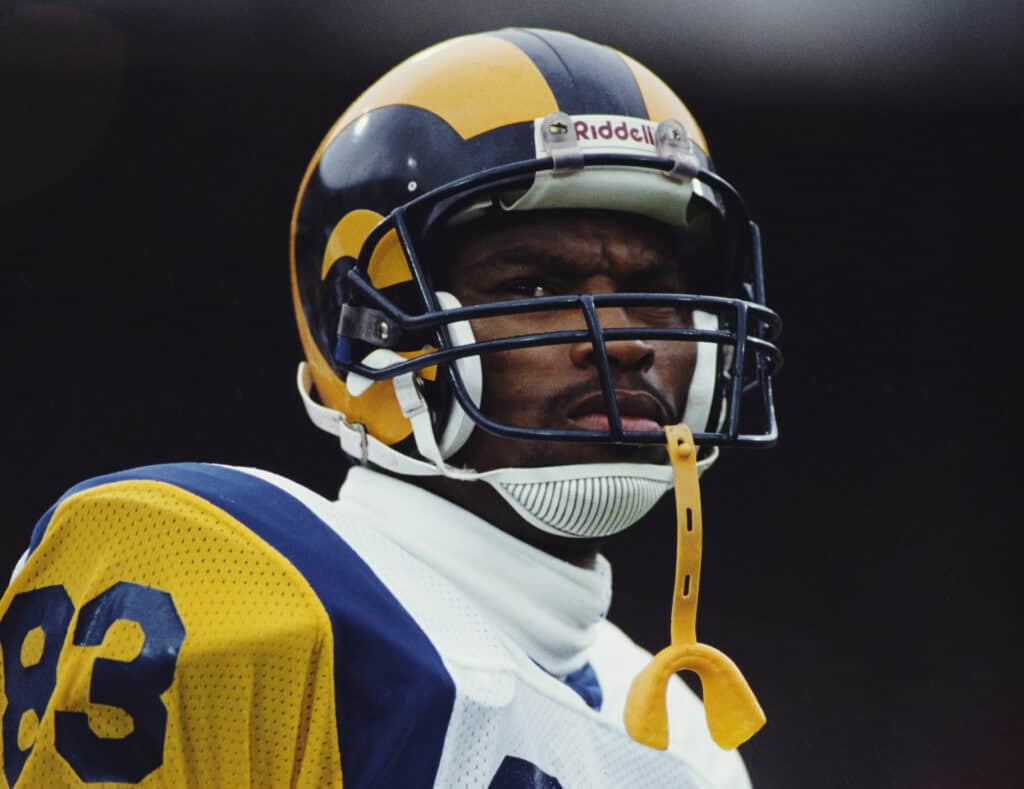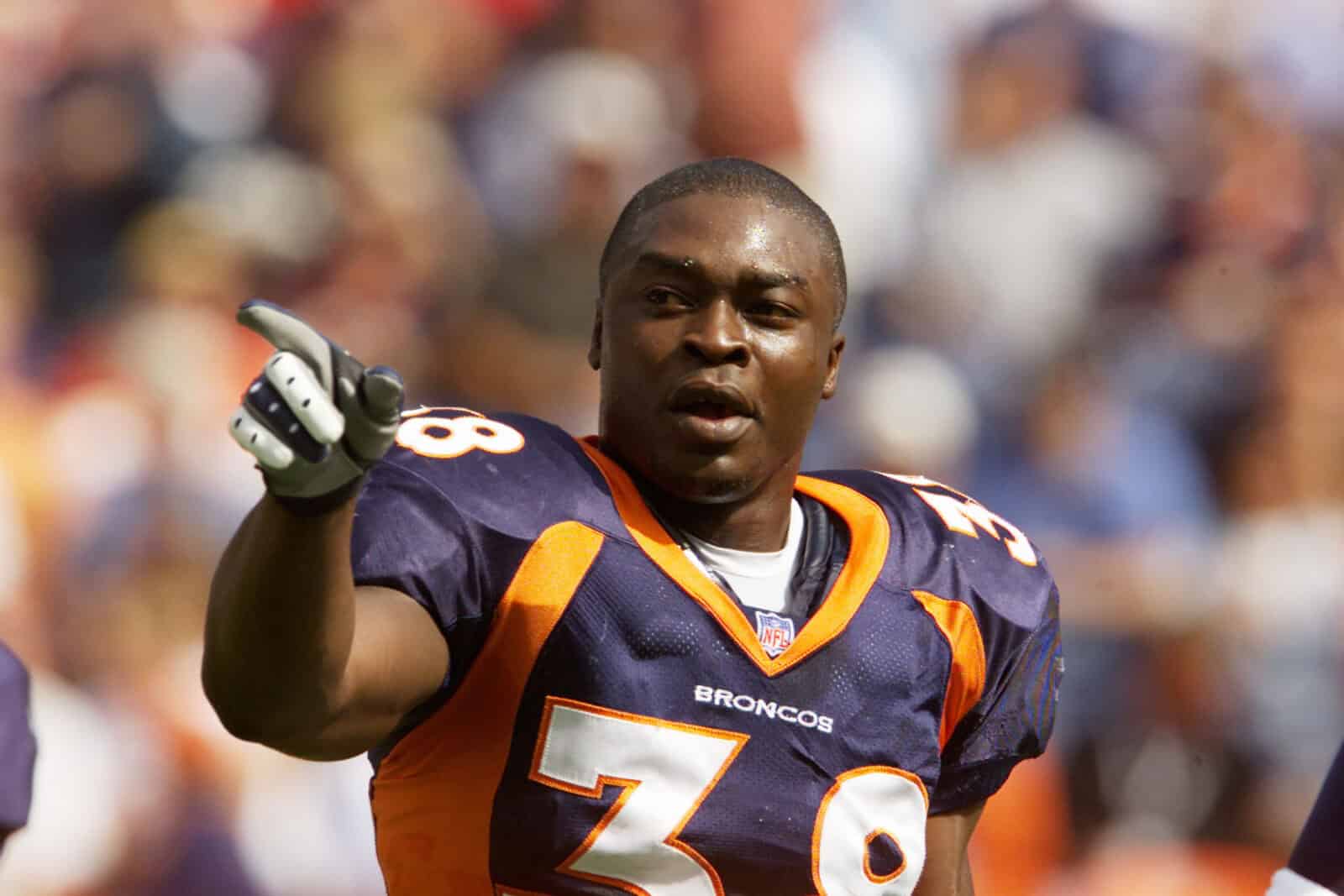
Not every NFL player takes the same path to the pros, and that was certainly the case with Mike Anderson.
After a football coach suggested he play a position that he didn’t like, Anderson decided to quit the sport and pivoted to play in his high school’s band instead.
He then signed up to serve in the Marine Corps after graduating with the idea of spending his future in the military.
At that point, Anderson was as far away from NFL stardom as possible.
However, he suited up for his base football team and was noticed by a junior college coach.
The coach asked Anderson to try his hand at college football, and he left the Marines to pursue the opportunity.
During his two years at a junior college, Anderson played running back and performed so well that he was nationally recognized.
He then matriculated to the University of Utah and rushed for 2,150 yards and 22 touchdowns in two seasons.
When I see #38 at RB for the Broncos, I think of Mike Anderson. Dude was tough and always ran hard. pic.twitter.com/F2Oa6sSeDv
— FB_Helmet_Guy (@FB_Helmet_Guy) November 20, 2023
Anderson made just enough noise in college that the Denver Broncos and head coach Mike Shanahan took a chance on him in the sixth round of the 2000 NFL Draft.
Their faith in him was rewarded when Anderson ran wild and was chosen as the NFL’s Offensive Rookie of the Year.
Although a position change and injury would limit him to just six more seasons, Anderson became an icon for anyone who is labeled as a longshot for greatness.
This is the story of Mike Anderson.
Choosing a Different Path
Michael Moschello Anderson was born on September 21, 1973, in Winnsboro, South Carolina.
There’s a strong possibility that NFL fans would have heard of him much sooner than they did if not for a single moment in high school.
When he went out for the football team at Fairfield Central in Winnsboro as a freshman, Anderson asked to try his hand at running back, but the head coach had other plans.
“He said, ‘You go with the offensive linemen,'” Anderson said. “I just walked away and did other things.”
Just like that, Anderson’s days as a prep ball player were over before they even began.
Since he was interested in music, Anderson decided to hang out with the band kids for four years and play the drums.
Being a percussionist continued well into his future life in the pros.
“…when I was in high school I used to love it, but now I don’t have the time like I use to have back then to play like I use to,” said Anderson in 2000. “I use to go home all the time and practice. I took my drums home and just practiced, practiced, practiced, but it is different now, but yes I love playing music. I used to love it then and I still love it. It is a way to relax and get away for a while.”
Marine Corps
As he was completing high school, Anderson considered what he would do next.
Turns out, a commercial he saw as a youth developed into an idea of what he could accomplish as a career and an eventual college degree.
“When I was a little kid, I would always see the commercial, ‘The Few, The Proud,’ and I always thought of it as a challenge. Could I do that?” Anderson said. “I wanted to get away from the neighborhood, and it was a good way to earn money for school, so I joined.”
After enlisting, Anderson was sent to Camp Pendleton in California and went through the rigors of training.
Mike Anderson:
• Discovered while playing football in the Marines
• 2 yrs of JUCO ball
• 2 yrs at Utah
• 6th round pick in 2000
• Won NFL Rookie of the Year as a 27-year-old rookieThank you to Mike and all the brave men & women who protect our freedom 🇺🇸 pic.twitter.com/WH7coX8SwS
— Tyler 🐶 (@OSheaSEO) June 30, 2023
He then worked in an artillery battery as a communications specialist and was deployed with the Marines to places like Kenya and Somalia for peacekeeping missions.
“…in the Marine Corps, you become part of what we call the squad unit. It is a twelve-man team and every guy has a job to do,” said Anderson. “If you go out on an observation post or a night post and you are observing, looking for the enemy, keeping an eye on the enemy and where they are located and things like that, each guy within their unit is depending on the next guy. With that situation, you are putting your life into another guy’s hands, and vice versa, that guy is depending on you with his life.”
During the months he was Stateside, Anderson played football with the “Cannon Cockers,” the 11th Regiment Marine Corps team at Pendleton, finally getting a crack at running back.
A Chance Meeting
Anderson didn’t plan on football being a career at the time; he just enjoyed playing and was pretty good at it.
Fortunately, one day, Mt. San Jacinto Junior College coach Bob Turley (who happened to be a retired lieutenant colonel for the Marines) watched a game in which Anderson stood out.
“It was obvious he was an exceptional athlete with great talent, speed and toughness,” Turley said. “He looked like a pretty strong, young Marine.”
The coach kept tabs on Anderson, and when his four-year stint with the Marines ended, Turley got a new running back for the Eagles.
Army, Navy, Air Force, Marines#VeteransDay2023 #VeteransDay
Alejandro Villanueva, Roger Staubach
Chad Hennings, Mike Anderson pic.twitter.com/RZHktERaYO— ᑭᖇO ᖴOOTᗷᗩᒪᒪ ᒍOᑌᖇᑎᗩᒪ 🏈 (@NFL_Journal) November 11, 2023
Four years of training and playing for the Marines had built strength and stamina in Anderson, and he quickly became a threat as a runner.
One of Anderson’s teammates, Lawrence Wells, was himself a former Marine and lined up at defensive back.
He knew no fear and frequently barrelled into teammates and foes alike with devastating tackles.
However, following a series of meetings between Wells and Anderson, the DB stopped trying to bring the thunder.
“All of a sudden, he sort of backed off. All the coaches looked like, what the heck? ‘Lawrence, why didn’t you take a shot?'” Turley said. “I think I’m done tackling furniture,” Walls told them.
Anderson Becomes a Ute
In 1996, Anderson was a six-foot, 230-pound beast of a back who ran for 1,511 yards and helped the Eagles win the L.A. Bowl.
“You can’t just pop [Anderson],” Turley said. “He has great balance. He can take a hit.”
Then, as a sophomore, he tore through opponents for 1,686 yards and was chosen as the JUCO Player of the Year for California.
Anderson also received JUCO All-American honors both years.
By the end of the 1997 season, college coaches scouted Anderson regularly, and he received a few scholarship opportunities to four-year schools.
Looking over the offers, he decided to spend his final two years at the University of Utah.
Bulldozer on Legs
Utah head coach Ron McBride needed to add a little heft to his offense.
In 1997, the Utes went 6-5, including a stretch near the end of the year where the program lost four of five.
With Anderson in the backfield, McBride had a workhorse who introduced himself to major college football by thrashing the Utah State Aggies for 150 yards in his first game with the team.
This week’s Badass of the Week for @utahfootball is Mike Anderson.
Anderson played 2 years for the Utes, rushing for 2,150 yards and 22 TD’s. Anderson was drafted by the Broncos and was named NFL Offensive Rookie of the Year in 2000. He joined the Marines out of high school. pic.twitter.com/kISbiu3MsG— Finesse Team Podcast (@finesseteampod) August 21, 2019
He finished the year by rushing for 1,173 yards on 244 attempts and 13 combined scores, including 12 on the ground, as the Utes went 7-4.
Then, as a senior, Anderson missed some time with injuries, but still put together a respectable 977 rushing yards and 11 combined scores.
On November 13 against New Mexico, he humiliated the Lobos for over 200 yards.
After finishing 8-3 during the regular season, Utah met Fresno State in the Las Vegas Bowl.
22 days until the Utes are back. S/O to Mike Anderson who ran for 254 yards in ‘99 Las Vegas Bowl. pic.twitter.com/YBOnshYRPh
— Classic Utah Pictures (@PicsUtah) October 16, 2020
Once again, Anderson tortured his opponent by hanging over 200 yards against the Bulldogs on the way to a close 17-16 win.
Following the season, he was selected for the first-team All-Mountain West team.
Anderson’s two years with the Utes produced 2,150 yards, 22 touchdowns rushing, and a 102.4 yards-per-game average (all-time best in program history), and he added five receptions for 51 yards and two touchdowns as a receiver.
Denver Picks Anderson
In the mid-to-late 1990s, Denver Broncos head coach Mike Shanahan consistently found gold in the later rounds of the NFL Draft.
With the 196th pick in the 5th round of the 1995 Draft, Denver took Georgia running back Terrell Davis.
Two years later, he was the MVP of Super Bowl XXXII in the Broncos’ victory over Green Bay.
Then, after Denver won Super Bowl XXXIII against Atlanta following the 1998 season, Shanahan and company grabbed another Georgia running back, Olandis Gary, in the 4th round of the 1999 Draft.
Broncos legend, Olandis Gary. #whoami @benmaller pic.twitter.com/WtIURRugBq
— Fields_Of_Green (@FieldsOfGreen6) October 6, 2022
During his rookie year, Gary rushed for 1,159 yards, his best season as a pro.
The Broncos were on a roll and selected Anderson (who would turn 27 in September that year) with the 189th pick in the 6th round of the 2000 NFL Draft.
“I was going against some great competition [in college], and guys who were much better known than I was,” Anderson said. “They were being talked about before the draft, and I wasn’t even really mentioned. But that’s OK, though, because it goes to show if you just dedicate yourself to something and you put a lot of hard work into it, it pays off in the end.”
Setting Records

Anderson began training camp alongside both Davis and Gary, but found himself thrust into the starter’s role when both veterans went down with injuries and played sparingly.
In Week 2 against Atlanta, Anderson tore through the Falcons for 131 yards and two touchdowns.
Happy Birthday to No. 3⃣8⃣ Mike Anderson! The Denver Broncos drafted Anderson, a RB, in the 2000 6th round. He's a @USMC member and the 2000 NFL Offensive ROY, rushing for 1,487 yards and 15 TDs! With Denver, Anderson amassed 4,649 rush./rec. yards, as well as 44 total TDs! 🫡 pic.twitter.com/arDucVS1Ff
— Mile High Moments (@MileHighMoments) September 21, 2024
Near the end of the game, the Mile High Stadium scoreboard announced that he was the first rookie in team history to rush for over 100 yards in a game.
“That was unbelievable. I was running off the field when they announced that,” he said after the game. “I looked up at it and thought, ‘Did I do that?'”
The magic continued a week later when he burst through the Oakland Raiders’ defense for 187 yards.
“I just wake up every day and think it’s unbelievable,” he said after the Raiders game. “I don’t know what’s down the road. I don’t know what’s planned for me. Right now, I’m not thinking that far ahead. Right now, I know I’ve been truly blessed.”
Offensive Rookie of the Year

It turned out that Anderson had even bigger moments “down the road” that year.
He was blessed in Week 14 when he blistered the New Orleans Saints with 37 carries for 251 yards (an NFL rookie record at the time) and four touchdowns.
#DENvsNO WEEK — Dec. 3, 2000 — Mike Anderson rushed for a then-NFL rookie record of 251 yards, as well as 4 TDs (a team record until 2003), as the Broncos won their 5th straight by beating the Saints 38–23! At the time, it was the 4th most rushing yards in a game in NFL history. pic.twitter.com/SVX19DCcse
— Mile High Moments (@MileHighMoments) October 15, 2024
Anderson’s uniform for the game was sent to the Pro Football Hall of Fame to memorialize the accomplishment.
At the end of the year, Anderson had 297 rushing attempts for 1,487 yards and 15 touchdowns, and added 169 more yards as a receiver.
MIKE ANDERSON, @Broncos RB – 25th Anniversary – The #189 overall pick in the 2000 NFL Draft, Anderson, rushed for 1487 yards and 15 TDs as a rookie and won the AP OROY (Per PFR) #BroncosCountry #Broncos #Denver #NFL #NFLUK #NFLTop100 #nfl100 #nflnews #NFLPicks #NFLTwitter pic.twitter.com/oRDSBASmCJ
— Pro Football Hall of Fame Ambassador (@PFHOFAmbassador) July 20, 2025
He set or tied several Broncos records, including rush attempts during a single season and total yards from scrimmage during a game.
The NFL then selected him as its Offensive Rookie of the Year, and Anderson was also chosen for the PFWA All-Rookie Team.
“I think without going into the military, I probably wouldn’t be at this point right now. I probably wouldn’t be playing,” he said.
Taking a Backseat
In a way, Anderson’s introduction into the NFL was easy compared to his basic training for the Marine Corps.
Going through training camp as a rookie had its own difficulties, but the physical component was something Anderson didn’t have an issue with.
“This is a game. It is fun. Boot camp – now that’s survival skills,” Anderson said when reflecting on NFL training camps. “That’s truly hard. If you are not totally focused and paying attention every minute of every day, you are risking the lives of the guys next to you. That’s something you need to hold with the utmost honor and respect.”
As he shared with the media in 2000, Anderson’s preparation for the military carried over to his incredible rookie year.
Mike Anderson Denver Broncos 2000 season 1500 yds rushing 15 TDs pic.twitter.com/tgZdaQUvtE
— Sergio Lovato (@serglova) August 2, 2025
However, as good as he was, Anderson still had to deal with teammates who were at an elite level athletically.
During the 2001 season, he split time with Davis and started only seven games while playing in all 16.
He still played well despite the limited carries and totaled 678 yards and four touchdowns as Denver went 8-8.
Davis retired before the 2002 season, and Coach Shanahan moved Anderson to fullback in an effort to help open running lanes for rookie Clinton Portis.
Mike Anderson Denver Broncos 2000-2005 pic.twitter.com/b9QYnfATa9
— Matt Deanda (@MattyD_303) July 22, 2023
As Portis played out of his mind on the way to NFL Offensive Rookie of the Year honors, Anderson started 12 games and rushed for 386 yards and had four combined touchdowns.
In 2003, Portis ran wild again and limited Anderson to five starts, 257 yards, and five combined scores as a fullback.
Injury and Comeback
Something else a disciplined, well-prepared athlete such as Anderson can’t avoid is injuries.
Before the 2004 season, Portis was traded to the Washington Redskins for cornerback Champ Bailey and a draft pick.
Anderson most likely would have been the Broncos’ lead back, but near the end of a preseason game, he was blocking during a punt and tore both groin muscles, ending his season.
Denver had drafted Oklahoma State running back Tatum Bell in the ‘04 Draft, but the bulk of the heavy lifting that season went to little-used backup Reuben Droughns, who ran for a career-high 1,240 yards.
After several months of intense therapy and rehab, Anderson returned in 2005 in great shape and was moved back to running back by Shanahan.
2005: Denver Week – #NYGiants punted the ball back to the Broncos who went on a 13 play, 87 yard, 8:19 minute drive that included a 4th & 2 conversion on a run by Mike Anderson & he later cashed in w/ a TD plunge (Strahan didn't agree & got a 15 yarder). Denver up 13-7 in 2Q pic.twitter.com/bgyyOv9WPv
— BigBlueVCR (@BigBlueVCR) October 16, 2025
While the Broncos went 13-3 behind quarterback Jake “The Snake” Plummer, Anderson was the starter over Bell and Ron Dayne, and ran for 1,014 yards and 13 combined touchdowns.
He also posted a career-high 212 receiving yards.
His stats set a few more NFL records, including the longest time between a player’s first and second 1,000-yard rushing seasons.
Trade to Baltimore and Retirement

Not long after the Broncos lost in the 2005 AFC Championship game to Pittsburgh, the team waived Anderson to stay under the salary cap.
Mike Anderson was the best player to wear No. 38 for the Broncos https://t.co/jz74FH45IL pic.twitter.com/2KmCFyJwpv
— Broncos Wire (@TheBroncosWire) May 13, 2024
Almost two weeks later, the Baltimore Ravens signed him to serve as a backup to Jamal Lewis.
The Ravens went 13-3 and lost to the Indianapolis Colts in the divisional round, while Anderson saw action in all 16 games and rushed for 183 yards and a touchdown.
He played in eight games in 2007, netting just 62 yards while Baltimore regressed to 5-11.
In February 2008, the organization waived Anderson, and he retired shortly after.
During his seven-year career, Anderson rushed for 4,067 yards and 37 touchdowns, and he caught 92 passes for 727 yards and five more touchdowns.
He was the NFL Offensive Rookie of the Year in 2000 and also picked for the PFWA All-Rookie Team.
Life In Retirement
Since leaving the NFL, Anderson, who is 52 years old, has mostly stayed out of the public eye.
He got into coaching high school football and was diagnosed with cancer in 2025.
Following his diagnosis, Anderson received treatment that involved Lupron Therapy (the use of hormone inhibitors).
References
https://broncoswire.usatoday.com
https://www.sports-reference.com
https://www.pro-football-reference.com
NEXT: The Life And Career Of Steve Atwater (Story)