To say that Hugh Green was a talented football player is an understatement.
During his college career at the University of Pittsburgh, Green demoralized opposing offenses.
From his defensive end position, Green was relentless in his pursuit of ball carriers.
He started all four years and posted double-digit sack totals each year, including an astounding 17 as a senior in 1980.
That same season, Green won a host of awards and even finished second in Heisman Trophy balloting.
The Tampa Bay Buccaneers selected him in the first round of the 1981 NFL Draft, and Green was moved to outside linebacker.
The @DolphinsTalk.com Miami Dolphins Alumni Player of the Day: Hugh Green pic.twitter.com/2zXWaAjWYS
— DolphinsTalk.com (@DolphinsTalk) March 1, 2022
Although he didn’t get as many sacks in the NFL as in college, Green was still a solid pro for 11 seasons with the Bucs and the Miami Dolphins.
Since retiring, Green has run his farm in Mississippi and has been involved in charity golf events and coached football.
This is the story of Hugh Green.
Bulldog Terror
Hugh Donell Green was born on July 27, 1959, in Natchez, Mississippi.
Happy birthday to former #Dolphins & #TecmoSuperBowl LB Hugh Green (62)! The former @Pitt_FB great was a 1st r.d pick by the #Buccaneers in '81 who was a 2x Pro Bowler & 1st Team All-Pro. He was traded to Miami in '85 & started 66 games over 7 years there. Happy birthday Hugh! pic.twitter.com/wNPHZz86ti
— SBlueman (@SBluemanTecmo) July 27, 2021
When he was six years old, Green’s father died, and he went to live with an aunt and uncle.
The sudden change forced him to mature quickly, but also gave Green a mindset to succeed.
As he grew, sports became an outlet that young Hugh turned into fuel.
By the time he arrived at Natchez High School, Green was already approaching six feet tall and closing in on 200 pounds.
His size, speed, and natural ability made opponents of the Bulldogs game plan to stop him.
In Green’s freshman and sophomore years, Natchez (now known as North Natchez) won a combined nine games.
The Bulldogs improved to 7-3 in 1975, with Green making enough big plays that college programs across the country began showing interest.
Then, in 1976, the senior put on a clinic in how to stop offenses.
As the Bulldogs went 8-3, Green performed so well that he was named Mississippi Defensive Player of the Year, a Prep All-American, All-Area, and All-Big Eight Lineman.
Additionally, he was one of the top 25 high school recruits in the nation.
Green was inducted into the Mississippi Sports Hall of Fame in 2009.
Choosing Pitt
Sorting through the college scholarship offers, Green was set on staying in-state and playing for Mississippi State in Starkville.
However, in 1977, Jackie Sherrill was hired as the new head coach at the University of Pittsburgh.
The Panthers had just won the national championship in 1976, with senior running back Tony Dorsett leading the way.
Sherrill had heard plenty about the kid from Natchez and convinced him to come to Pitt instead.
It just so happened that the Panthers also had a new defensive coordinator (and future Dallas Cowboys head coach) in Jimmy Johnson, who liked his players fast and aggressive.
“Whatever you ask him to do on the football field, he’ll do it better than anybody has ever done it before,” Johnson said. “You can build your entire defense around him. Heck, you can build your entire team around him. If Hugh Green is on your team, you’re automatically one of the finest in the country.”
Green definitely fit the bill, and he signed on to help Pitt repeat as national champs.
Now 6’2” and 220 pounds, the freshman was installed as a starting defensive end, and he didn’t disappoint.
Sports Illustrated called him the “Baddest Cat in the Game.”
We call him Hugh Green.
Happy Birthday to a Pitt legend and one of the best defensive players in the history of college football 🥳 pic.twitter.com/VIeGmKvyH7
— Pitt Football (@Pitt_FB) July 27, 2023
In his very first game as a collegian, Green terrorized third-ranked Notre Dame.
While the Panthers’ home crowd looked on, Green made 11 tackles, including two sacks and blocked a punt for good measure.
Although Pitt lost 19-9, Green’s performance against very good competition as a freshman were shocking.
By the end of the Panthers’ 9-2-1 season, Green had tallied 58 total tackles, 15 tackles for a loss, 12 sacks, five forced fumbles, four passes defended, and two blocked kicks.
He was then named a second-team All-American and first-team All-Big East.
The Sports World Takes Notice
Pitt began the 1978 season with a 4-0 record before finishing 8-4.
Green continued his assault on ball carriers by getting 66 total tackles, 12 tackles for a loss, 13 sacks, six forced fumbles, and six passes defended.
The defensive end was so dominant that he was named to the program’s All-Time team after playing only two years.
The Baddest Cat in the Game.
Hugh Green was one of the best to play at Pitt on Saturdays.#H2P pic.twitter.com/vqbbKKyBQy
— Pitt Football (@Pitt_FB) October 20, 2018
Furthermore, Green was chosen as a Consensus All-American and first-team Big East, and NFL coaches took notice.
“Hugh Green is the most productive player at his position I have ever seen in college,” said then-Tampa Bay Buccaneers head coach John McKay.
In 1979, Green was even better as he netted 76 total tackles, 14 tackles for a loss, 11 sacks, six forced fumbles, and six passes defended as the Panthers went 11-1 and beat Arizona in the Fiesta Bowl.
His stats led to first-team All-Big East and Unanimous All-American nods.
Green was chosen as the Best Defensive Player in America by the New York Times, added to Street and Smith Magazine’s All-Decade Team, and was also the first junior to be selected as a Lombardi Trophy finalist.
One Bad Cat
Since its establishment in 1935, the Heisman Trophy has primarily been awarded to offensive players.
However, Green was firmly on the institution’s radar before his senior season in 1980.
“We had started campaigning [for the Heisman] in the summer leading up into it,” said Green in 2012. “During that period of time in college football, the focus had shifted more toward defense.”
Sports Illustrated put Green on its September 1 cover and added the headline “Baddest Cat in the Game.”
"Bad ass" was not a big enough word for Hugh Green at Pitt pic.twitter.com/uV88dh1R96
— ᑭᖇO ᖴOOTᗷᗩᒪᒪ ᒍOᑌᖇᑎᗩᒪ 🏈 (@NFL_Journal) October 30, 2021
Pitt was ridiculously talented in 1980.
Not only did the Panthers boast Green, but also fellow defenders Rickey Jackson, Bill Maas, Tim Lewis, and Carlton Williamson.
The offense had QB Dan Marino and linemen Jimbo Covert, Russ Grimm, and Mark May.
Each athlete would play in the NFL, and Marino, Jackson, Grimm, and Covert have been inducted into the Pro Football Hall of Fame.
In honor of 99 days until college football, we have College Football Hall of Famer and Pitt Panther, Hugh Green pic.twitter.com/vCIUXONGix
— Walk-On Redshirts (@walkonredshirts) May 22, 2020
That season, Green destroyed people and had no less than an NCAA-best 17 sacks (UNC’s Lawrence Taylor had 16), 77 total tackles, 11 tackles for a loss, seven forced fumbles, and six passes defended.
“People were petrified of Green,’’ Pitt linebacker Sal Sunseri said. “But they couldn’t run away from him because we had Rickey Jackson on the other side of the line.’’
Pitt was 4-0 before losing to Florida State on October 11, the season’s only blemish.
During halftime at home on November 8 against Louisville, Green’s number 99 was retired by the school.
Narrowly Missing the Heisman
Before meeting the University of South Carolina in the Gator Bowl, Green was blessed with a plethora of postseason awards.
Among them were the Lombardi Trophy, the Maxwell Award, and the Walter Camp Award.
Green was named a first-team All-Big East member for the fourth year in a row and a Unanimous All-American for the second year in a row.
The UPI chose Green as its Player of the Year and Lineman of the Year, and the Sporting News named him its Player of the Year.
When it came time to name the winner of the Heisman, South Carolina running back George Rodgers was chosen, with Green finishing second.
9️⃣9️⃣ Days until Pitt Football
» Hugh Green » DE » 1977-80
» Pitt-record 49 career sacks
» Maxwell Award, Lombardi Award
» Heisman Trophy runner-up
» 1st Round Pick by Tampa Bay#H2P pic.twitter.com/pTxvhCGKVB— Pitt Football (@Pitt_FB) May 28, 2021
At the time, it was the highest a defensive player had been chosen in the Heisman voting until Michigan’s Charles Woodson won it in 1997.
“You could talk all day about Hugh Green,” said Sherrill. “I don’t think there had ever been a defensive player who played as well and as consistently from his first game to his last.”
When the Gamecocks and Rodgers met Green and the Panthers a few weeks later, number 99 and his mates bottled up the running back and beat South Carolina soundly, 37-9.
Since leaving school, Green has been inducted into the College Football Hall of Fame, and he has been listed by several media outlets as one of the best college football players in history.
First Rounder
There was no shortage of pro teams who wanted Green’s skills on their roster.
John McKay had admired his ability, and the Bucs selected Green with the seventh overall pick in the first round of the 1981 NFL Draft.
He was definitely needed.
Two years prior, Tampa Bay shocked the sports world by going 10-6 and advancing to the NFC Championship Game in the franchise’s fourth season of existence.
A year later, the Bucs regressed to 5-10-1 with a defense that went from best in the NFL to 20th overall in just one season.
Happy Birthday Hugh Green#Buccaneers pic.twitter.com/XlBeOGh9la
— Old Time Football 🏈 (@Ol_TimeFootball) July 27, 2026
Green then joined a roster with franchise legend Lee Roy Selmon at defensive end.
He was also moved to outside linebacker in McKay’s 3-4 defense.
Now donning number 53, Green started all 16 games as a rookie and made his presence felt with three sacks (one year before sacks became an official NFL stat), three forced fumbles, and two interceptions.
Hugh Green earns his place among the greatest in Buccaneers history 👏@CokeFlorida | #WeAreTheKrewe pic.twitter.com/J437T8BmmR
— Tampa Bay Buccaneers (@Buccaneers) August 21, 2025
Tampa Bay improved to fourth overall defensively and went 9-7 before losing to the Dallas Cowboys, 38-0, in the wild-card round.
Following the season, Green was named to the PFWA’s All-Rookie Team.
All Pro

The NFL players went on strike in 1982, and the regular season was scaled back to nine games.
Green started every contest and posted 2.5 sacks, two forced fumbles, and a pick.
He was then named a second-team All-Pro and voted to his first Pro Bowl.
The Bucs went 5-4 before losing to Dallas once again in the First Round of the postseason, 30-17.
During the game, Green grabbed up a fumble by Cowboys quarterback Danny White and returned it 60 yards for a score.
Hugh Green TD #Buccaneers pic.twitter.com/84hMZKgFVd
— Old Time Football 🏈 (@Ol_TimeFootball) July 28, 2023
In 1983, Tampa Bay won only two games, but Green was a man possessed.
On October 16, he hounded St. Louis Cardinals QB Neil Lomax with one-and-a-half sacks and intercepted a Lomax throw before returning it 33 yards for a touchdown.
Week 7, 1983#Cardinals #Buccaneers
Lomax 17-22-166-3-1
Hugh Green pick 6
Thompson20-30-212-3-2
Bell 1-23-1
34-27 #Cardinals pic.twitter.com/iuzqPhp64t— Old Time Football 🏈 (@Ol_TimeFootball) September 5, 2023
After the season, he was voted to the Pro Bowl again and also named a second-team All-Pro for the second year in a row.
Then, halfway through the Buccaneers’ 6-10 season in 1984, Green was in a serious car accident.
”The nature of the injury is facial and thigh,” said a team spokesman, Rick Odioso. ”The injuries do not appear to be serious. They would not seem to affect football on a long-term basis.”
Green’s injuries limited him to eight games and four sacks.
Trade to Miami
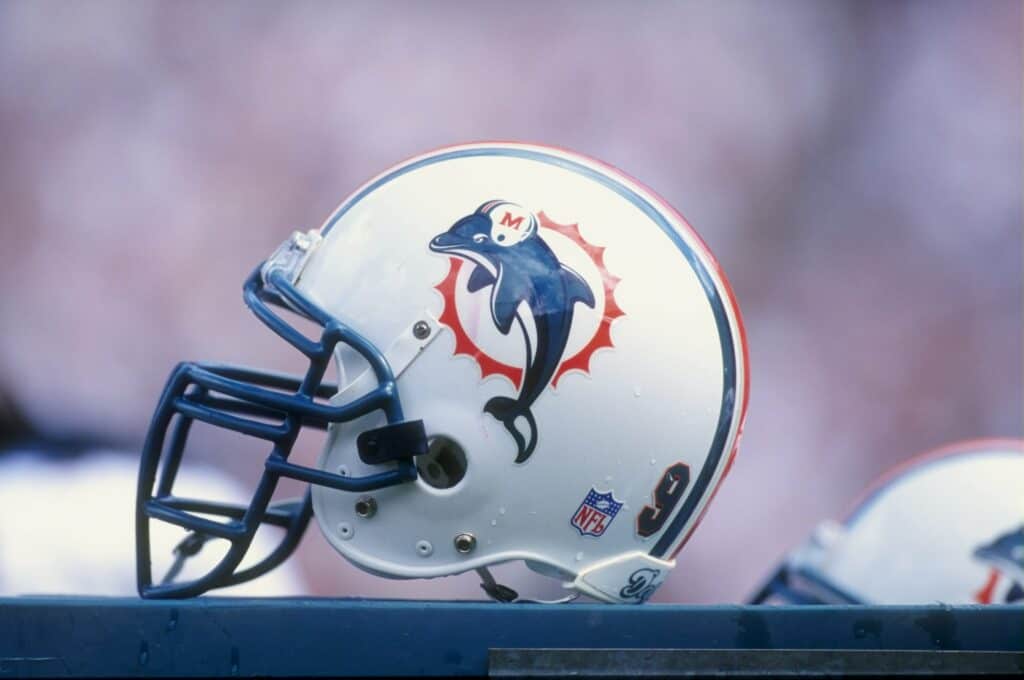
When the 1985 season kicked off, Green was fully healed from his injuries.
He started the first five games of the season until the Bucs traded him to the Miami Dolphins after an October 6 loss to the Chicago Bears.
The Dolphins had played in Super Bowl XIX at the end of the 1984 season and lost to the San Francisco 49ers, 38-16.
Head coach Don Shula wanted to pack a little more punch on defense and traded first and second-round picks in the 1986 NFL Draft to Tampa Bay for Green.
He was then added to a defense that had finished ‘84 ranked seventh overall in the NFL.
Three Dolphins who were EXCELLENT/HOF LBs elsewhere extended their careers in Miami….Hugh Green, Junior Seau and Joey Porter…. pic.twitter.com/fZnOKxoqlZ
— The Return (@TheReturn84) April 10, 2022
For the remainder of the ‘85 season, quarterback Dan Marino (Green’s former Pitt teammate) and receivers Mark Duper and Mark Clayton paced the offense while Green did his part with five sacks, a forced fumble and an interception.
Miami went 12-4, including an upset of the then-undefeated Chicago Bears juggernaut in Week 13.
In the AFC Championship Game, the ‘Fins were upset by New England, 31-14.
Giving His All
The next two years were rough for Green as he dealt with more injuries and started just four games total.
Finally, in 1988, he was back on the field for all 16 games and tallied 2.5 sacks as Miami went 6-10, a rare losing record for Coach Shula.
Everyone at https://t.co/jTLjtUE3tr would like to wish former Miami Dolphins linebacker Hugh Green a Happy Birthday today! pic.twitter.com/jDTnHbLBLs
— DolphinsTalk.com (@DolphinsTalk) July 27, 2026
A year later, the Dolphins improved slightly to 8-8 while Green nailed quarterbacks 7.5 times, tying his career high for sacks.
In 1990, he started every game for the third year in a row and had two sacks.
Miami returned to the postseason after a five-year absence by going 12-4 and slipping past Kansas City, 17-16, in the wild-card round before losing to the Buffalo Bills in the divisional round.
Then, in 1991, the franchise went 8-8.
Green started just three times while appearing in 11 games and getting one sack.
When the season concluded, so did his career.
During his 11 years in the league, Green had 37.3 sacks, 11 forced fumbles, seven fumble recoveries, six interceptions, and two pick-sixes (the NFL didn’t keep an official count of tackles until 2001).
He was a two-time All-Pro, a two-time Pro Bowler, and was a member of the PFWA’s All-Rookie Team in 1981.
Life After Football
Since retiring from the NFL, Green has mostly stayed out of the spotlight.
He has dabbled in coaching and has made appearances at Pitt for special occasions, and played in celebrity golf tournaments.
For the past several years, Green has lived in his hometown of Natchez, Mississippi, where he runs a farm with his family.
References
https://pittsburghpanthers.com
https://profootballresearchers.com
https://footballfoundation.org
https://pittsburghpanthers.com
https://www.pro-football-reference.com
NEXT: The Life And Career Of Bob Griese