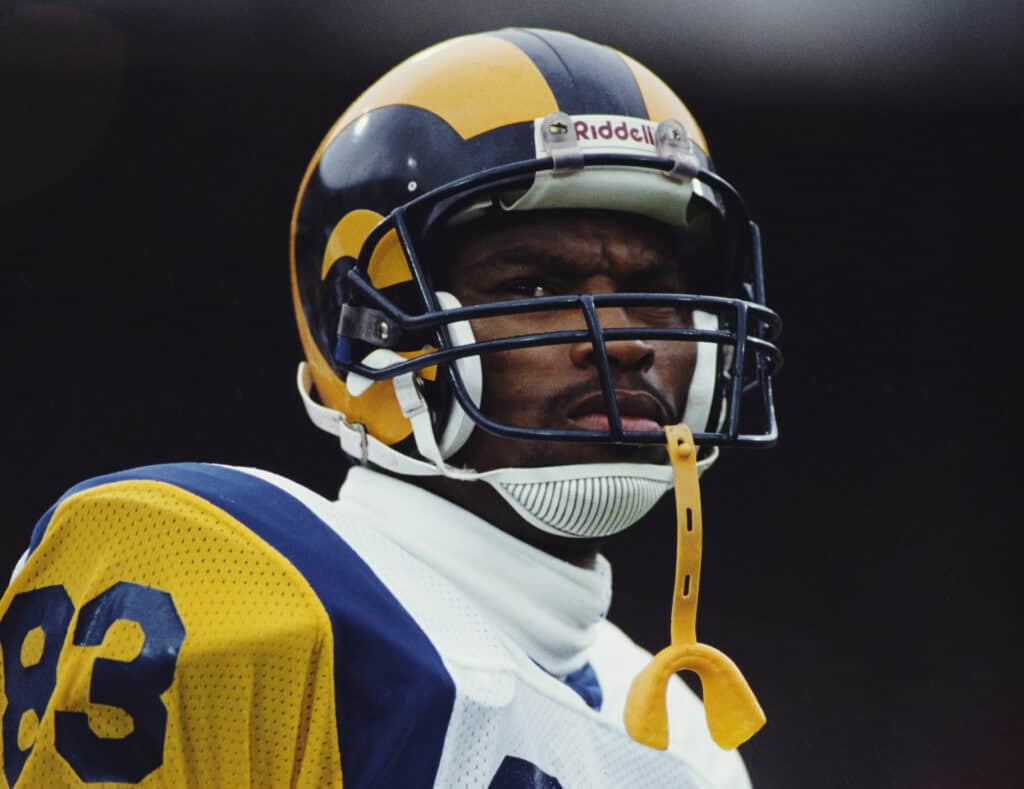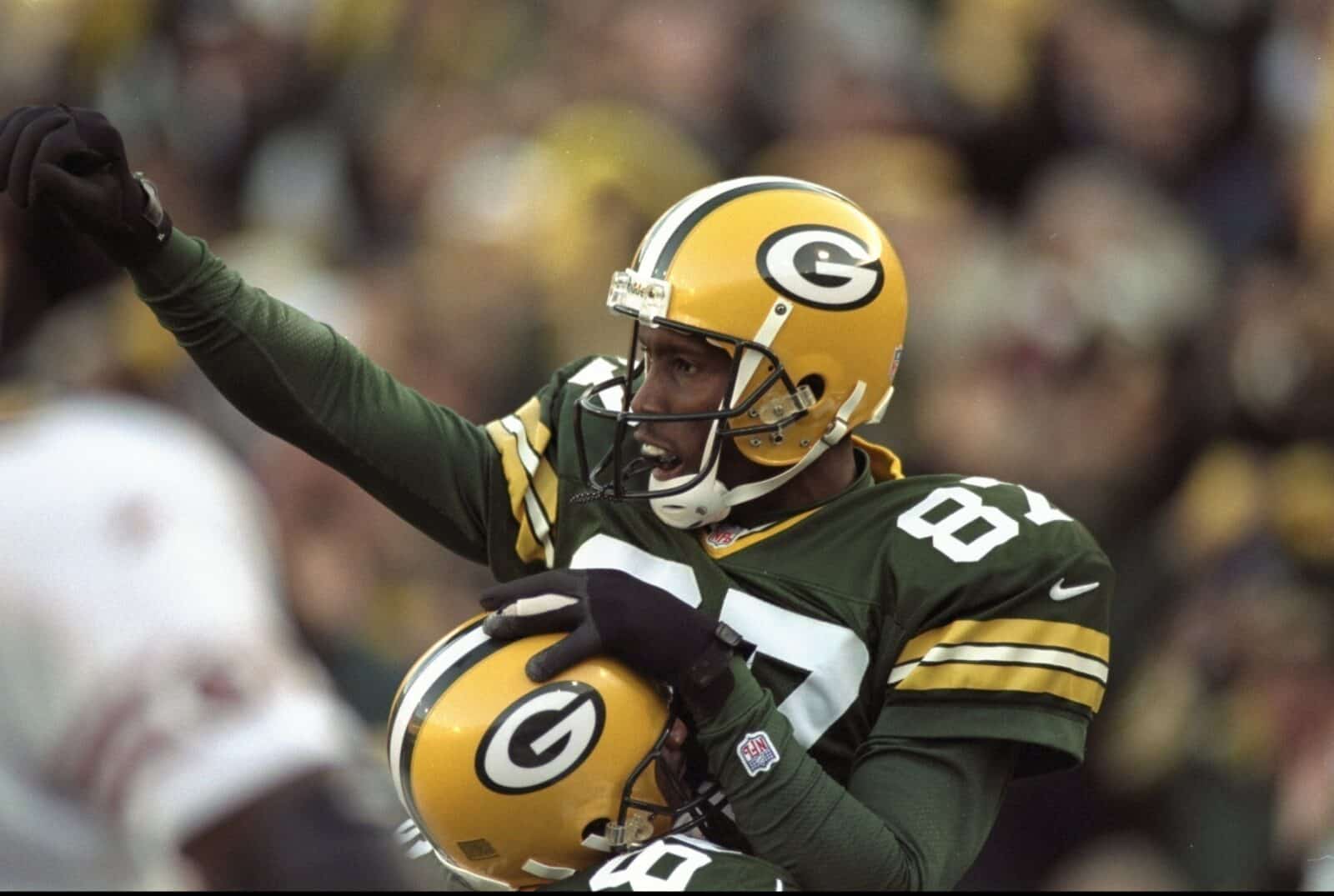
In 1996 and 1997, the Green Bay Packers appeared in two straight Super Bowls.
Understandably, the talk of the NFL world at the time was the play of Packers quarterback Brett Favre, who had gone from the Atlanta Falcons bench to Super Bowl QB in the span of five years.
There were other valuable pieces of the team, of course, who contributed to Green Bay’s return to prominence.
One of them, receiver Robert Brooks, was one of Favre’s favorite targets.
Happy 53rd Birthday to Robert Brooks!
Green Bay Packers (1992–1998)
Denver Broncos (2000)🏈 Games played = 100
🏈 Receptions = 309
🏈 Receiving yards = 4,276
🏈 Touchdowns = 32🏆 Super Bowl XXXI champion
💯 Green Bay Packers Hall of Fame#NFL #GreenBay #Packers #GoPackGo pic.twitter.com/fFdjMLNo7O
— JVAN (@VanderlansJim) June 23, 2023
During the 1995 season, Brooks made the game look easy when he came out of nowhere to grab 102 passes for 1,497 yards and 13 touchdowns.
All his stats were career-highs, and his yardage mark set a then-franchise record.
Furthermore, Brooks reached the end zone so often that he turned the Lambeau Leap into a cultural phenomenon in Green Bay.
Although he had another great year in 1997, injuries limited the receiver and forced him to retire following the 2000 season.
Since then, Brooks has been busy as a husband, father, music producer, businessman, coach and pastor.
This is the story of Robert Brooks.
Two-Sport Star at Greenwood
Robert Darren Brooks was born on June 23, 1970, in Greenwood, South Carolina.
From the jump, he was enamored with the sport of football.
His parents signed him up to play Pee Wee ball when he was in first grade, and Brooks never looked back.
By the time he reached Greenwood High School, Brooks was a celebrated running back, and he also shone on the track.
When he was a sophomore, Brooks was named a starter in the backfield, and he continued starting for the Eagles through his senior year.
During track season his junior year, Brooks won the state title in the 110-meter and 300-meter hurdles.
Then, during his senior year, the running back bolted for 14 touchdowns and just over 700 yards.
He was then voted All-State and was selected to play in the Shrine Bowl.
Brooks repeated as the state hurdles champ in the 110- and 300-meter hurdles in the spring.
Choosing South Carolina
As he was starring for the Eagles, Brooks kept a close eye on the Clemson Tigers football program.
His dream was to suit up at running back for the school and play near home.
The only problem was, Clemson head coach Danny Ford wanted Brooks, but he also wanted him to redshirt his freshman year.
That was something the kid did not want to do.
Meanwhile, Joe Morrison and the staff at the University of South Carolina were ready to bring in Brooks and start him right away.
Couple Packer WRs on the wall here in the Letterman Lounge at South Carolina… Robert Brooks/Sterling Sharpe 🙌🏼 pic.twitter.com/CfgRFXF7zQ
— Ben Fennell (@BenFennell_NFL) October 19, 2019
The coaches also wanted to switch him to receiver.
“I can’t remember catching a ball in high school because we ran the ball so much,” Brooks quipped. “I wanted to go to Clemson. I wanted to be a Clemson running back in the day. … But I just did not want to be redshirted. That was my personal preference. I was like, ‘I’m going to school where they won’t redshirt me.’”
The Gamecocks needed someone to replace Sterling Sharpe, who had been a record breaker for the program before getting drafted by the Green Bay Packers in the first round of the 1988 NFL Draft.
Morrison pitched the idea to Brooks, and he accepted the challenge.
All-American
After breaking camp in late summer 1988, Brooks was a starter alongside quarterback Todd Ellis and running back Harold Green (a future NFL Pro Bowler).
It didn’t take long for Ellis to develop a strong rapport with Brooks.
The six-foot, 180-pound receiver wasn’t super-fast, but he had just enough speed, fluid movement and sure hands.
During a game against sixth-ranked Georgia on September 24, Ellis found Brooks for a highlight-reel, 36-yard touchdown.
#Gamecocks #TBT Robert Brooks also helped popularize the "Lambeau Leap" during seven standout seasons w/ Green Bay pic.twitter.com/X0tkKR9m2M
— South Carolina Gamecocks (@GamecocksOnline) September 19, 2013
The Gamecocks (ranked 14th at the time) upset the Bulldogs 23-10.
“By the time we get into the season (Brooks’ freshman year),” Ellis said, “you had to think about trying to get him the ball on every possession.”
Two weeks later against Virginia Tech, Brooks zipped through the Hokies’ kick coverage unit for a spectacular 98-yard touchdown.
USC won the contest by two points, 26-24.
At that point, the Gamecocks were 6-0, but they struggled down the stretch, losing four of their next six to finish 8-4 (including a 34-10 loss to Indiana in the Liberty Bowl).
Brooks was a hit with 32 total catches for 473 yards and four touchdowns along with 481 yards and a touchdown as a kick returner.
He was named a Freshman All-American after the season.
Coming Up Short
Tragedy struck the USC program in February 1989 when Coach Morrison passed away suddenly from a heart attack while playing racquetball.
Sparky Woods came over from Appalachian State and took a shine to Brooks.
“I think (Brooks) weighed about 175 pounds soaking wet,” Woods said. “He. Could. Run. And he was dangerous when he got that ball in his hands.”
The Gamecocks went 5-1-1 to begin the 1989 season and included another upset win over 23rd-ranked Georgia in Georgia on September 30.
On October 28 against 20th-ranked North Carolina State, Ellis sustained a career-ending injury on a pass attempt intended for Brooks.
Instead, he took a massive hit from a Wolfpack defender that tore the quarterback’s MCL.
“I got hit just as I threw it and we probably win the ball game that day (if it goes differently),” Ellis said. “Literally (my) last play, I was trying to find a way to get the ball to him.”
USC lost, 20-10, then lost two more games in the last three weeks, ending the season 6-4-1.
Brooks caught 34 passes for 471 yards and four touchdowns while returning 24 kicks for 564 yards.
Racking Up Yards

The Gamecocks began the 1990 season with a 4-1 record before limping to a 6-5 finish.
Although there was a new quarterback in Bobby Fuller, Brooks still caught 33 passes for 548 yards (16.6 yards-per-reception average) and a career-high six touchdowns.
Additionally, he had 246 yards on 10 kick returns.
Happy Birthday Robert Brooks, out of Greenwood, South Carolina and @GamecockFB ; 8 year @NFL career, 309 receptions, 4,276 yards, 32 TD’s, Super Bowl Champion, @packers Hall of Fame, longest pass reception in @NFL history ( 99 yards); 50 Today… pic.twitter.com/XOWfhpHiBQ
— Larry in Missouri (@LarryInMissouri) June 23, 2020
Racking up yardage was another Brooks highlight in 1991 when he caught 55 passes from Fuller for 684 yards (both career-highs) and five touchdowns, and 317 kick return yards.
USC limped through the regular season with a 3-6-2 record in Brooks’ final year.
During his four seasons in Columbia, Brooks caught 154 passes for 2,176 yards and 19 touchdowns, and rushed the ball six times for 85 yards.
On special teams, he returned 70 kicks for 1,608 yards and one touchdown, and 28 punts for 251 yards.
He was a Freshman All-American and a first-team All-South Independent in 1991, and Brooks was inducted into the South Carolina Athletics Hall of Fame in 2023.
Becoming a Packer

In 1991, Ron Wolf became the new general manager of the Green Bay Packers.
His first year on the job produced a 4-12 record under then-head coach Lindy Infante.
When the season concluded, Wolf got to work.
Infante was fired, and he hired former San Francisco offensive coordinator and quarterbacks coach Mike Holmgren to take over.
Next, the GM traded that year’s first-round pick for Atlanta Falcons backup QB Brett Favre.
My all-time favorite Green Bay Packers
QB: Brett Favre, Matt Hasselbeck, Steve Bono 😉
RB: Edgar Bennett, Aaron Jones, AJ Dillon, Ryan Grant
FB: John Kuhn
WR: Robert Brooks, Sterling Sharpe, Donald Driver, James Jones, Bill Schroeder
TE: Mark Chmura, Keith JacksonDef/ST below.. pic.twitter.com/1vhiZgI25y
— Scott F (@TheFrizz87) November 11, 2022
Then, in the draft, Wolf took Florida State corner Terrell Buckley in the first round, and Brooks arrived with the 62nd overall selection in the third round, although he wasn’t overly thrilled with the news initially.
“When people asked me where I would like to get drafted, I said anywhere but Green Bay,” Brooks recalled. “And I think I named another team that was a cold-weather team. I mean, I’m a South Carolina guy, but I was living in Arizona, so I’m looking for a hot-weather team to draft me.”
Seminoles running back Edgar Bennett was added in the fourth and Boston College tight end Mark Chmura was selected in the sixth.
That year, while Favre developed into one of the best signal-callers in NFL history, Brooks mainly watched from the sideline while taking mental notes from Sterling Sharpe.
Sharpe had just missed Brooks at South Carolina, and the rookie watched in awe as the former Gamecock solidified himself as one of the best in the game at that point.
While Brooks started one contest, caught 12 passes and one touchdown, Sharpe hauled in 108 passes and 13 touchdowns.
Green Bay went 9-7 and just missed the playoffs.
More Playing Time
The Packers’ rebirth began in 1993.
Following the franchise’s run to three consecutive NFL titles and victories in the first two Super Bowls between 1965 and 1967, Green Bay had a rough couple of decades.
Beginning in 1968 through 1992, the organization qualified for the playoffs only twice.
Finally, in 1993, came a breakthrough.
“I remember when Mike Holmgren first came there, and he said, ‘You guys may have not been in the playoffs for a lot of years, but make no mistake about it, our goal is the Super Bowl’” Brooks said in 2006.
Things got really interesting in Wisconsin when former Philadelphia defensive end Reggie White kicked off the new and improved free agent era by unexpectedly signing with Green Bay.
April 6, 1993: Free agent Reggie White signs a 4-year $17 million dollar contract with the Packers. pic.twitter.com/Hvsa34Dp32
— This Day In Sports Clips (@TDISportsClips) April 6, 2021
Then, with Favre slinging Sharpe the ball 112 times, the Pack went 9-7 and won its first playoff game since 1982 with a 28-24 win over Detroit in the wild-card round.
Brooks, meanwhile, didn’t start a single game, but caught 20 passes for 180 yards.
He was also becoming a special-teams demon with 23 kick returns for 611 yards, a return touchdown, and an NFL-best 26.6 average yards per return.
In the postseason, he broke loose with three catches, 39 yards, a receiving touchdown, and 134 all-purpose yards in Green Bay’s 27-17 loss to Dallas in the divisional round.
His performance led then-receivers coach Jon Gruden to predict big things for Brooks in 1994.
“We expect him to have a dynamite year for us,” said Gruden. “He’s probably the most highly conditioned athlete on our team, so we have to assume he’s going to be durable.”
Sure enough, Brooks became a starter alongside Sharpe in 1994 and caught 58 passes for 648 yards and four touchdowns while adding 612 combined yards and a touchdown as a punt and kick returner.
Today in 1994: Packers kick off preseason with 14-6 win over Rams at Madison's Camp Randall Stadium.
Green Bay gets TDs from Edgar Bennett (1-yard run) and Robert Brooks (2-yard pass), while limiting LA to just two field goals. pic.twitter.com/aHGDctwkYT
— Packers History (@HistoricPackers) August 7, 2024
Green Bay went 9-7 again, beat the Lions again in the wild-card round before losing to Dallas (yet again) in the divisional round.
1995 and the Lambeau Leap
As the 1995 season was set to kick off, it looked like the Packers were in trouble.
Near the end of 1994, Sharpe was found to have spine abnormalities at the base of his neck that required surgery.
Unfortunately, the condition was enough of a concern that Sharpe retired after only seven years in the NFL.
Sports media scribes looked at the Packers receiver room and only saw Brooks, former New York Giant Mark Ingram, and rookie Antonio Freeman, and believed the team was in trouble.
Oops!
“They were predicting us to win, possibly four games, because we had lost Sterling Sharpe and some other players,” Brooks said. “I was able to be a part of that great run we had.”
The team instead won 11 games and defeated Atlanta and San Francisco in the playoffs before losing for the third consecutive year to Dallas, this time in the NFC Championship game.
Favre and Brooks got on the same page and connected 102 times for 1,497 yards and 13 touchdowns (all career-highs and his yardage mark set a franchise record not broken until 2014).
The receiver also led the league with a 99-yard touchdown catch against Chicago on Monday Night Football in Week 2.
That tied a league record with a dozen other pass-catchers.
Robert Brooks shares #Packers memories & recalls how he popularized the Lambeau Leap.
Watch: http://t.co/PyahD0vHRg pic.twitter.com/Cte8TTKxMi
— Green Bay Packers (@packers) April 19, 2015
Brooks found paydirt so often that he jump-started the infamous “Lambeau Leap” end zone celebration that was started two years prior by teammate LeRoy Butler.
“We always tease about the Lambeau Leap because everybody gets the whole thing wrong,” Brooks said. “I tell Leroy, ‘Remember, there was a two-year gap before anybody ever named that jump into the stands the Lambeau Leap, so you’re really not the Lambeau Leap guy.’ But I like to give him a hard time about it.”
1996
Losing to Dallas three consecutive years in the playoffs was frustrating to say the least, and the Green Bay players were over it.
“We thought we were good enough to go to the Super Bowl in ’95, but we fell short there at the very end,” Brooks explained. “And Reggie (White), myself, Brett (Favre), some of the leaders on the team, we had made our mind up in the locker room in Dallas that we were going to the Super Bowl the next year. In our mind, that team was destined to go.”
Brooks did his part by starting the first seven games of the season with 23 receptions for 344 yards and four touchdowns.
Today in 1996: Richie Cunningham's 42-yard FG with three seconds left gives Packers 17-15 preseason win over Ravens. Green Bay gets TDs from Robert Brooks and Brian Satterfield in the victory.
The game marks the Packers' first game in Baltimore since 1982. pic.twitter.com/LYhR6sG487
— Packers History (@HistoricPackers) August 17, 2023
Just when the receiver and the team were humming along, Brooks tore his ACL and patellar tendon, and broke his femur during a play on Monday Night Football in Week 7 against San Francisco, ending his season.
He watched from the sidelines as the Packers adjusted for the loss of Brooks with castoffs Don Beebe, Desmond Howard and Andre Rison, who was signed by the club in November.
Green Bay lost back-to-back games in November (including the Cowboys in Week 12) but ended the season on a five-game winning streak.
In the postseason, the Pack beat the 49ers and Carolina (who had upset the Cowboys in the divisional round) before meeting the New England Patriots in Super Bowl XXXI.
Sept 11, 1995: @Packers Brett Favre and Robert Brooks combine to equal the longest pass completion in NFL history. Favre threw a bomb to Brooks for a 99 yard TD. The Packers beat the Bears on MNF. Green Bay also owns shortest TD pass. 4" to Don Hutson. pic.twitter.com/yW5nGUKKej
— Jack Eich (@jackeichsays) September 11, 2019
Rison and Freeman both caught touchdowns, and Howard took a 99-yard kick return to the house and was named the game’s MVP in Green Bay’s 35-21 triumphant victory.
Comeback Player of the Year

Bringing the Lombardi Trophy home to Green Bay nearly three decades after the organization won Super Bowl II was a perfect ending to the 1996 season.
The Packers players and coaches, however, were not content.
Brooks rehabbed like a madman and returned ready to play in 1997, a feat hardly believed by the Packers’ athletic trainer, Pepper Burress.
“He has made the greatest recovery I’ve ever seen in my 20 years as a trainer,” Burruss gushed at the time.
Green Bay went 13-3 for the second year in a row, and Brooks started 15 games, caught 60 passes for 1,010 yards, and seven touchdowns.
Following the regular season, he was named the Pro Football Writers’ Association Comeback Player of the Year.
Today in 1997: Packers clinch third-straight NFC Central title with 17-6 win at Tampa Bay. Robert Brooks and Dorsey Levens each find the endzone, while Green Bay's defense registers four sacks and two takeaways, plus holds the Bucs' offense to just 161 yards. pic.twitter.com/moXy5MkJRA
— Packers History (@HistoricPackers) December 7, 2022
In the playoffs, the Pack beat Tampa Bay in the divisional round and San Francisco in the NFC Championship game.
That victory put Green Bay in Super Bowl XXXII against John Elway and the Denver Broncos.
Pre-game oddsmakers installed the Packers as 11-point favorites.
Elway didn’t listen to the hype as both he and running back Terrell Davis led the Broncos to a surprise 31-24 win, as Davis was named the MVP.
During the contest, Brooks had three catches for 16 yards and rushed once for five yards.
Forced Retirement, Comeback, and Second Retirement

The following summer, Brooks went under the knife again to fix a herniated disk.
He then suited up for his seventh season, but played the entire year in pain, ending with 31 catches for 420 yards and three scores as the Pack went 11-5 and lost to the Niners in the wild-card round.
Great having former #Packers WRs Robert Brooks & Derrick Mayes here last night. More photos: http://t.co/t4R5VSYQi8 pic.twitter.com/tSTkmRBHel
— Green Bay Packers (@packers) November 10, 2014
Brooks was still experiencing discomfort and reluctantly retired after the 1998 season.
“I just couldn’t cover it up any more,” the Packers wide receiver said. “I found myself missing so many practices and taking so much medication just to practice. When you get to that point, I think it’s time to call it quits.”
Almost two years later, the Denver Broncos reached out and signed Brooks in August 2000.
He remained mostly tethered to the bench as the offense ran through receivers Ed McCaffrey and Rod Smith.
After playing in just four games and catching three passes for 51 yards in Denver’s 11-5 season, Brooks retired for good.
During his career, the receiver caught 309 passes for 4,276 yards and 32 touchdowns, rushed the ball for 75 yards, and had 589 punt return yards and 1,237 kick return yards and two touchdowns.
He was a Super Bowl winner and Comeback Player of the Year, and in 2007, Brooks was inducted into the Packers’ Hall of Fame.
Life After Retirement
When Brooks’ NFL career ended, he was only 30 years old, and the rest of his life was staring him in the face.
Some family members asked him to start a record label, and the former receiver did so by founding the label “Shoo-in 4 Life” after his football nickname.
While producing two CDs with his label, Brooks helped raise his three kids with his wife, Diana, and helped run a chain of fast-food restaurants, a real estate company, and also co-authored two self-help books.
Brooks, who will be 56 in June, has also coached receivers at Brophy College Prep in Phoenix and started a church in Arizona.
References
www.pro-football-reference.com
NEXT: The Life And Career Of Bart Starr