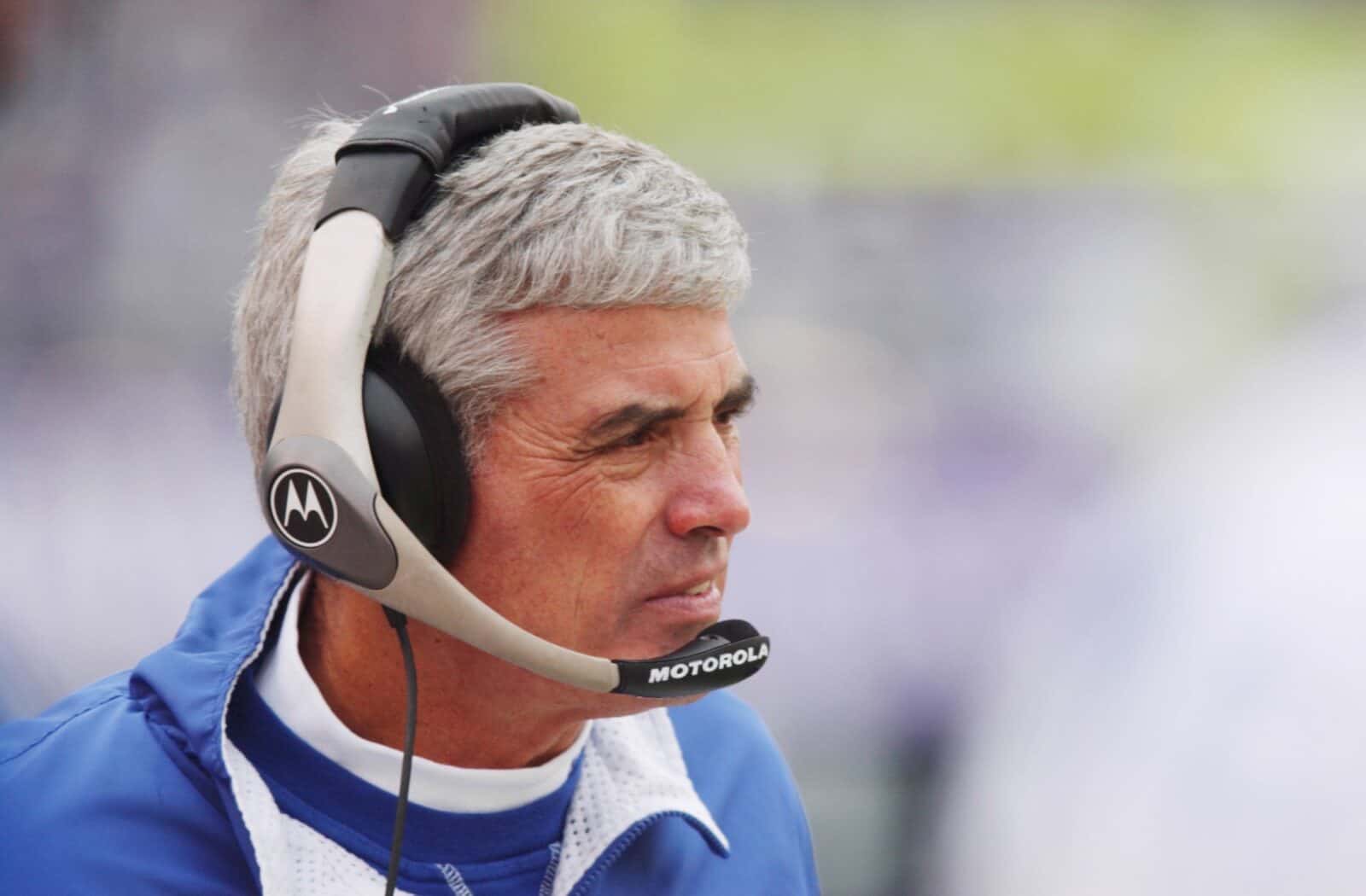
“Playoffs? Don’t talk about—playoffs?! You kidding me? Playoffs?! I just hope we can win a game! Another game!”
If NFL fans are unaware of who Jim Mora is, they may be familiar with his memorable quote.
As head coach of the Indianapolis Colts from 1998 through 2001, Mora was present for the rise of quarterback Peyton Manning and a franchise that was starting to make noise in the AFC South.
Indianapolis made the playoffs in 1999 and 2000, but lost against their first postseason opponent both years.
Big things were expected to happen in 2001, perhaps even a run to the Super Bowl.
However, after a loss to the San Francisco 49ers in Week 11, the Colts were 4-6, and the disappointment was palpable.
When he faced the media after the game, a reporter asked Mora about the team’s chances to make the playoffs, and Mora responded with incredulity and frustration.
Those who knew the coach understood where he was coming from.
After a long rise through the college and NFL ranks as an assistant, Mora was finally named a head coach in the short-lived United States Football League, where he won two championships.
Happy 90th birthday to Saints Hall of Famer, Coach Jim Mora! 🎈#Saints | @Invisalign pic.twitter.com/kxIiN0uJkh
— New Orleans Saints (@Saints) May 24, 2025
He was then hired to lead a woeful New Orleans Saints team in 1986.
Before Mora arrived, the franchise had never made the playoffs.
During his 11-year tenure, New Orleans made the postseason four times, and Mora was named the NFL’s Coach of the Year in 1987.
Since leaving the Colts after the 2001 season, Mora retired from coaching and pivoted to radio and television work.
Now 91 years old, he continues to exercise religiously while watching the coaching career of his son, also named Jim.
This is the story of Jim Mora.
All-City at University High
James (Jim) Earnest Mora was born on May 24, 1935, in Glendale, California.
Happy Birthday Jim Mora #Saints #Colts pic.twitter.com/a9GTozCaVp
— Old Time Football 🏈 (@Ol_TimeFootball) May 24, 2026
Mora’s father, Mario, worked in the nearby film industry, and his mother, Helen, was a homemaker.
There were no traces in his early life that Jim would become a renowned football coach and developer of talent.
In fact, when asked in 2001 how he got into football, the coach gave a simple answer: “It just happened,” he said.
He matriculated to University High School in LA and played football while also joining the Boy Scouts, eventually rising to an Eagle Scout.
During his time playing for the Wildcats, Mora played receiver and defensive end.
As a pass-catcher, he was selected All-City, although none of the big-time college programs in the state showed any interest.
Not wanting to give up on his dream to play collegiately, Mora decided to enroll at tiny Occidental College in nearby Eagle Rock, a suburb of LA.
Mora and Kemp Lead the Tigers
Mora not only chose Occidental to play ball, but he also wanted to play with quarterback Jack Kemp, a player he competed against in high school.
Kemp and Mora quickly became friends, and both were starters and eventual co-captains of the Tigers.
Jim Mora and Jack Kemp taken from the 1957 Occidental College yearbook. They were co-captains. https://t.co/beZaWY536v
— Shane (@Indy_RedDevil) September 1, 2021
In 1953, their first season playing together, the program went 6-2, then 4-4-1 in 1954.
Occidental won six games again in 1955 while Kemp passed for 561 yards and five touchdown passes.
Mora (who played end/receiver) caught 19 of those passes for 319 yards and three scores.
Jack Kemp to Jim Mora touchdown pass, Occidental College, 1956… @SpyboySportsCap @JeffKempTeam pic.twitter.com/2PjzsT7kpv
— Steve Massey ~ Steeler Revolution (@1947Steelers) February 18, 2024
Then, during their final season together in 1956, Kemp passed for 1,123 yards and found Mora 32 times for 328 yards and a touchdown, while Occidental went 3-6.
The teammates took their leadership positions as co-captains seriously and didn’t go looking for trouble.
“I was a straight arrow,” Mora remembered. “During football season, I wouldn’t even drink a Coke. We weren’t hellraisers by any means.”
Following the 1956 season, Kemp would depart for a decade-long career in the NFL.
Mora Returns to Occidental
While attending Occidental, Mora joined the Marine Platoon Leaders program and was commissioned as a second lieutenant upon his college graduation.
Since the NFL didn’t want him, Mora reported to Quantico, Virginia, and spent three years of active duty in Virginia and at Camp Lejeune in North Carolina.
He played football for the Marines and made himself valuable to each team he played for.
“I started out as an eighth-string tight end and ended up starting,” Mora said in 2001.
In 1960, his military requirement ended, and Mora returned to Southern California ready to work in education as a teacher and coach.
That’s when new Occidental head coach Vic Schwenk reached out and asked Mora to join his staff in 1961.
For the next three years, the Tigers went 18-9 while Mora coached both the offensive and defensive linemen for a whopping $500 per season.
Head Coach
Schwenk left to become a scout for the LA Rams after the 1963 season, and at 29 years young, Mora was named in his place.
In his first season leading the Tigers in 1964, the team went 5-4.
Then, in 1965, Occidental went 8-1 and beat Whittier College for the conference championship and a 10th overall national ranking of small-college programs.
“Of the years I coached here and played here, that was probably the highlight,” said Mora in 2013.
The Tigers went 5-4 in 1966, but Mora’s team the previous year was still viewed as a major accomplishment.
John Ralston, then the head coach at Stanford, asked Mora to become his linebackers coach.
Although he had a good job at Occidental, Mora couldn’t pass up the opportunity.
“The dean of the faculty told me I was making a major mistake,” Mora recalls. “He said I could stay at Occidental the rest of my life, have tenure on the faculty, coach, settle in the community, and have a nice life. But I said, ‘Hey, I’ve got to give it a shot.’”
Vagabond Coach
Mora had spent six years at Occidental as a coach in a relatively stable environment.
Just like most coaching lifers, he would soon spend several years as a vagabond coach rising through the ranks of the profession.
From 1967 through 1977, Mora coached at Stanford, Colorado, UCLA, and Washington as a defensive coach, including defensive coordinator at Washington for three years.
In 1978, he left the college world behind to become the defensive line coach for the Seattle Seahawks under head coach Jack Patera.
The franchise was only two years old at the time, but Mora was ready for a change of pace.
His first year with the organization saw a 9-7 record followed by another 9-7 season in 1979.
Stalwart PFHOF DE Carl Eller, whose familiar #81 shone for the Vikings from 1964-78, finished his career as #71 for the Seahawks in 1979. #MINvsSEA pic.twitter.com/ZY7NpFQC6z
— Kevin Gallagher (@KevG163) December 10, 2018
Mora had the opportunity to work with former Minnesota Vikings great Carl Eller during his final season as a player that season.
Seattle sank to 4-12 in 1980 while Mora tutored rookie defensive end Jacob Green, who would become an All-Pro and Pro Bowler.
After a 6-10 season in 1981, Mora left for the East Coast to become the defensive coordinator for Ron Meyer, the new head coach of the New England Patriots.
“That turned out to be the toughest move I ever made,” Mora said. “My family was in a comfort zone in Seattle, and we loved it there.”
Jump to the USFL
It may have been difficult to move to the opposite side of the country, but Mora had a good crew in 1982, including rookie linebacker Andre Tippett, a future Hall of Famer.
The NFL Players Union went on strike that year, and the season was shortened to nine games.
New England went 5-4 while Mora’s defense was ranked seventh overall in the NFL and fifth in the AFC in points allowed.
When the season ended after a 28-13 loss to Miami in the playoffs, Carl Peterson, the general manager of the Philadelphia Stars of the upstart United States Football League, called Mora.
Peterson had worked with Mora at UCLA, and the GM asked the coach if he was interested in leading the Stars.
Mora said no, then eventually agreed.
“I finally said, ‘What the hell, I can always go back to the NFL if this thing (the USFL) doesn’t make it,’” Mora said.
It turned out that the Stars were pretty good.
How about a little USFL 🏈
Philadelphia Stars ⭐️ @PhilHecken #USFL @jeffpearlman pic.twitter.com/1aGJPYIuvJ
— Goat Jerseys (@GoatJerseys) January 18, 2019
The team had running back Kelvin Bryant and quarterback Chuck Fusina, who had played at Penn State and just missed being named the Heisman winner in 1978.
Mora’s “Doghouse Defense” was ruthless, led by linebacker Sam Mills.
Philly’s 15-3 record sent them to the USFL championship, where the Stars lost to the Michigan Panthers, 24-22.
Mora and the Stars Thrive
A year later, the Stars played even better, netting a 16-2 record and a 23-3 beatdown of the Arizona Wranglers in the USFL Championship game.
Mora was named the USFL’s Coach of the Year after the season.
Jim Mora of the Philadelphia/Baltimore Stars. 48-13-1 in three seasons. 1984 & 85 USFL Champions. Was Hc for New Orleans 1986-96 and Indianapolis 1998-2001. Record of 125-106 in the NFL. 1987 NFL Coach of the Year. pic.twitter.com/9XXd4mULuj
— Cool Old Sports (@CoolOldSports) November 21, 2022
Before the 1985 season, New Jersey Generals owner Donald Trump led a push to play games in the fall instead of the spring, in direct competition with the established NFL.
That posed a problem for the Stars, as they had trouble securing a place to play.
Unfortunately, despite the fact that the franchise was extremely popular, the team had to relocate to Baltimore for the ‘85 season.
The USFL’s 1985 Baltimore Stars had four future NFL Head Coaches on their staff. Head Coach Jim Mora, Defensive Backs Coach Dom Capers, Defensive Assistant Vic Fangio and Defensive Coordinator Vince Tobin. The Stars won their 2nd straight USFL Championship defeating Oakland 28-24 pic.twitter.com/MXn9gloMpZ
— Cool Old Sports (@CoolOldSports) September 15, 2023
Now playing in a new city, the Baltimore Stars continued their dominance by going 10-7-1.
They beat Trump’s Generals in the quarterfinals and the Birmingham Stallions in the Semifinals before winning their second championship in a row after beating the Oakland Invaders, 28-24.
New Orleans Hires Mora

Eventually, Trump and his fellow USFL owners took the NFL to court, claiming the established league held a monopoly over professional football.
A jury agreed, but only paid Trump $3 after federal antitrust law tripled his original $1 award.
30 Years Ago Today: Donald Trump & the USFL owners, looking for $1.7B from NFL for being a monopoly, are awarded $3 pic.twitter.com/iZBMTKyWR1
— Darren Rovell (@darrenrovell) July 29, 2016
The USFL ended up shutting its doors in 1986.
By then, Mora was already gone.
His success in the USFL brought interest from the NFL, including the Philadelphia Eagles and Arizona Cardinals.
Jim Finks, who had just been hired as the general manager of the New Orleans Saints, met with Mora to pitch the open Saints job.
“I had a chance to meet Jim Finks for the first time; it was sometime probably in December. We met in Philadelphia in the airport. And he had just been hired as the GM and president. I walked out of that meeting, and I wanted to be the head coach of the New Orleans Saints,” said Mora in 2021.
Turnaround in the Big Easy
The Saints had existed since 1967, and notable head coaches Tom Fears, Hank Stram, Dick Nolan, and Bum Phillips had led the franchise through the 1985 season with little success.
Even with the collective football knowledge of each coach, New Orleans had never made the postseason.
When Mora arrived in 1986, the organization already had quarterback Bobby Herbert, center Joel Hilgenberg, tight end Hoby Brenner, defensive end Frank Warren, safeties Dave Waymer and Brett Maxie, linebacker Rickey Jackson, and kicker Morten Andersen.
Mora’s first NFL Draft in 1986 added guard/tackle Jim Dombrowski, running backs Dalton Hilliard, Reuben Mayes, and Barry Word, and linebacker Pat Swilling.
"The Dome Patrol"
The #Saints' linebacking corps of the 1980s and '90s
Rickey Jackson
Sam Mills
Vaughan Johnson
Pat SwillingThe most decorated linebacking corps in #NFL history pic.twitter.com/BrVQPANiHR
— Kevin Gallagher (@KevG163) October 7, 2024
In addition to Swilling and Jackson, Mora’s favorite linebacker from the Stars, Sam Mills, signed with the club, as did former Jacksonville Bulls linebacker Vaughan Johnson.
Together, the quartet quickly became one of the best linebacker units in league history and earned the moniker “Dome Patrol” because New Orleans played in the Superdome.
One year after going 5-11, the Saints went 7-9 in 1986, and there was a feeling of something big on the horizon.
Playoffs at Last

The 1987 season was reduced to 15 games because of another players’ strike, but New Orleans was ready.
Now in his second season as head coach, Mora whipped his charges into shape after a 3-3 start, especially after a Week 6 loss to then-division rival San Francisco.
Following the 24-22 loss, Mora responded to a question from the media by blistering his team.
A Jim Mora rant after a week 7 loss to the 49ers turns the #Saints 1987 season around. pic.twitter.com/EydfNs0n1f
— Old Time Football 🏈 (@Ol_TimeFootball) February 20, 2023
“Could’ve, would’ve, should’ve’” is the difference in what I’m talking about! The good teams don’t come in and say “Could’ve.” They get it done! All right? It’s that simple! I’m tired of saying “Could’ve, should’ve, would’ve.” That’s why we ain’t good enough yet! ‘Cause we’re saying “Could’ve” and they ain’t!” shouted Mora. “I’m pissed off right now. You bet your ass I am. I’m sick of coulda, woulda, shoulda, coming close, if only.”
The Saints got the hint and won nine straight to close the year with a 12-3 record (the most regular-season wins in team history at that point), and Mora was named the NFL Coach of the Year.
Unfortunately, the franchise’s first-ever trip to the postseason ended abruptly when the Minnesota Vikings beat them handily, 44-10, in the wild-card round.
Playoffs and Disappointment
In 1988 and 1989, New Orleans had winning records both seasons but failed to make the playoffs.
When the team began the 1990 season 1-3, they traded for Dallas Cowboys backup QB Steve Walsh.
An 8-8 finish earned a playoff spot, but a loss to Chicago in the wild-card round ended the season.
Jim Mora #Saints pic.twitter.com/jlS7s5y7JP
— Old Time Football 🏈 (@Ol_TimeFootball) October 16, 2022
Walsh proved to be better as a backup, especially when Hebert returned in 1991 after sitting out the 1990 season in a contract dispute and reclaiming the starting spot.
New Orleans started hot, posting a 9-1 record before finishing 11-5.
The Dome Patrol led a second-ranked defense, and all four linebackers made the Pro Bowl (Swilling was also named the NFL’s Defensive Player of the Year), the first time in NFL history that four linebackers from the same team made the all-star event.
Unfortunately, just like in 1987 and 1990, the Saints lost in the wild-card round, this time to Atlanta, 27-20.
In 1992, all four linebackers again made the Pro Bowl, and Hebert passed for 3,287 yards as New Orleans won 12 games.
Then, much to the angst of their fans, the team lost for the fourth time in the wild-card round, this time to Philadelphia, 36-20.
Mora Leaves the Crescent City
Just when it seemed like Mora had turned around a moribund franchise, the good times came to a halt.
In 1993, the team drafted tackle Willie Roaf, fullback Lorenzo Neal, and corner Tyrone Hughes, started 5-0, then crashed to 8-8.
The following summer, Finks, who Mora had clicked with since the beginning, resigned from his position due to cancer.
He would pass away the following year.
“After Finks left, we kind of got screwed up as an organization, but I’m not blaming anyone else,” Mora said. “It just wasn’t the same. We didn’t handle things well, and we faltered.”
New Orleans signed former Rams QB Jim Everett before the 1994 season, but the team responded with a 7-9 record.
A 0-5 start in 1995 brought another 7-9 finish.
Then, eight weeks into the 1996 season, Mora couldn’t take it anymore.
26 years ago today, Saints coach Jim Mora with one of the greatest postgame NFL interviews ever.
“Diddly poo…” 🤣🤣🤣 pic.twitter.com/h5aDuBYf7r
— TodayInSports (@TodayInSportsCo) October 20, 2022
After a pathetic offensive effort derailed the team in a 19-7, Week 8 loss to Carolina, the coach came unglued in the post-game press conference.
“Well, what happened was, that second game we got our ass kicked,” ranted Mora. “Errr—the second half, we just got our ass totally kicked. We couldn’t do diddly … poo offensively. We couldn’t make a first down. We couldn’t run the ball; we didn’t try to run the ball. We couldn’t complete a pass—we sucked. The second half, we sucked…”
Not even 24 hours later, Mora stepped down as head coach of the Saints.
“So I quit. I’m not proud of the fact, but I knew I was hurting myself, my family, the team, and the organization. It was horribly hard, because I knew what I was doing, and knew the repercussions. But I did it because it was what I had to do,” Mora said in 2001.
Mora’s 93 wins with New Orleans were the most in team history until Sean Payton passed him in 2016.
Indy Hires Mora

In 1997, NBC hired Mora to be a color analyst for NFL games.
Later that year, the Indianapolis Colts finished the season with a disappointing 3-13 record.
The team fired head coach Lindy Infante and vice president Vince Tobin and then hired Bill Polian to lead the organization into the future.
Former #Colts head coach Jim Mora stated that he will not attend the ceremonies honoring Peyton Manning this October https://t.co/ChYYfnbkrU pic.twitter.com/VgUWoUJiCS
— Jake Arthur (@JakeArthurNFL) July 6, 2017
When Polian learned that Mora was interested in coaching again, the two got together, and the GM hired the next coach of the Colts.
“We needed someone who could point this team in the right direction, who would give them the kind of professionalism and discipline they needed,” Polian says. “Jim Mora filled that bill completely.”
The Colts Return to the Postseason
Before Mora coached a game for Indy, Polian got to work rebuilding the team.
In the 1998 NFL Draft, he selected Tennessee quarterback Peyton Manning with the first overall pick.
Manning struggled as a rookie, and the Colts went 3-13 again.
The 1999 NFL Draft brought running back Edgerrin James, and together, Mora, Manning, and James got the team to 13 wins, the most during a regular season since the 1968 Baltimore Colts.
Por pleito con el ex gerente general de @Colts, Jim Mora no irá a develación de estatua de Manning 😡#NFLxESPN 🏈
👉 https://t.co/L0Rs6pzg1J pic.twitter.com/XyfmjhYxwj
— NFLLive_esp (@NFLLive_esp) July 6, 2017
A week after the regular season, Indy lost to the Tennessee Titans in the divisional round, 19-16.
Another playoff appearance after a 10-6 record in 2000 produced another loss, this time to the Miami Dolphins in the wild-card round.
“Playoffs!?”

Receiver Reggie Wayne was added in the 2001 NFL Draft, but the team took a huge step back that year.
Things started well when the Colts began the season 2-0.
But by Week 11, Manning was throwing interceptions in bunches (he would tally 23 by season’s end), leading to a 4-5 record before facing the San Francisco 49ers.
Looking back: Former Colts HC Jim Mora wrapping up 2001 training camp at Rose-Hulman. https://t.co/oweYdBdEBb pic.twitter.com/aGeiKscf91
— Tom James (@TJamesIndState) July 25, 2016
It only got worse when the QB tossed a career-worst four picks in one game, and the Niners cruised, 40-21.
Now 4-6, the Colts were drastically underperforming.
In the postgame press conference, a local reporter asked Mora about the team’s chances to make the playoffs.
20 years ago today, the @Colts head coach Jim Mora with one of the most iconic press conferences ever.
Playoffs?!? pic.twitter.com/exevg0lWqA
— TodayInSports (@TodayInSportsCo) November 25, 2021
“Playoffs? Don’t talk about—playoffs?! You kidding me? Playoffs?! I just hope we can win a game! Another game!” and exasperated Mora replied.
The coach then angrily referenced Manning’s poor day, leading to a strained relationship between the two.
Jim Mora to skip Peyton Manning's Colts statue unveiling: 'I would just feel a little bit awkward there' https://t.co/2QfWj2HF8c pic.twitter.com/boLYPcASm9
— Around The NFL (@AroundTheNFL) July 6, 2017
The Colts only won twice more the rest of the way and ended the season 6-10.
After Indy beat Denver in the last game of the regular season, Mora told the media he intended to continue leading the Colts.
“I will not quit; I want to coach here,” Mora said in anger as his eyes welled with tears. “I should be the coach here. I’ll just tell you that right now, I should be.”
Two days later, he was fired.
Bona Fides
After leaving Indianapolis, Mora did not coach again.
Instead, he worked as an analyst for the NFL Network and Fox Sports Radio.
During his coaching career, Mora had a 125-106 record and guided both the Saints and Colts to multiple playoff appearances.
Since retiring from the coaching profession, Mora has watched his son, Jim L. Mora, rise through the ranks and become a head coach at the college and NFL levels.
🚨🚨THIS IS AMAZING🚨🚨
Legendary #Saints head coach Jim Mora has an 85-minute weight-lifting session twice a week and a Peloton session three times a week.
Mora is 90 years old and in better shape than some players.
😱😱😱
pic.twitter.com/LPJ80JdI7q— MLFootball (@MLFootball) February 21, 2026
Ever cantankerous, the elder Mora, now 91 years old, has kept Father Time at bay by working out and playing golf several times each week and spending time with his wife, Connie.
He is a member of the Louisiana Sports Hall of Fame, the New Orleans Sports Hall of Fame, the New Orleans Saints Hall of Fame, and the Occidental College Hall of Fame.
References
https://www.indianapolismonthly.com
https://www.neworleanssaints.com
https://www.indianapolismonthly.com
https://www.pro-football-reference.com
NEXT: The Life And Career Of Tom Dempsey (Story)