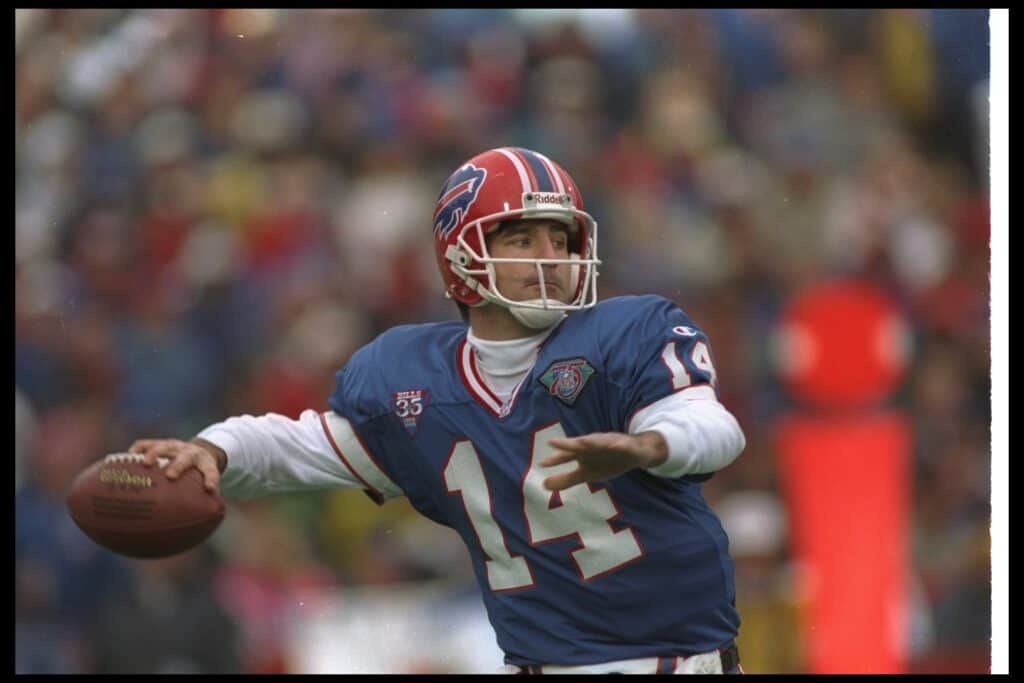
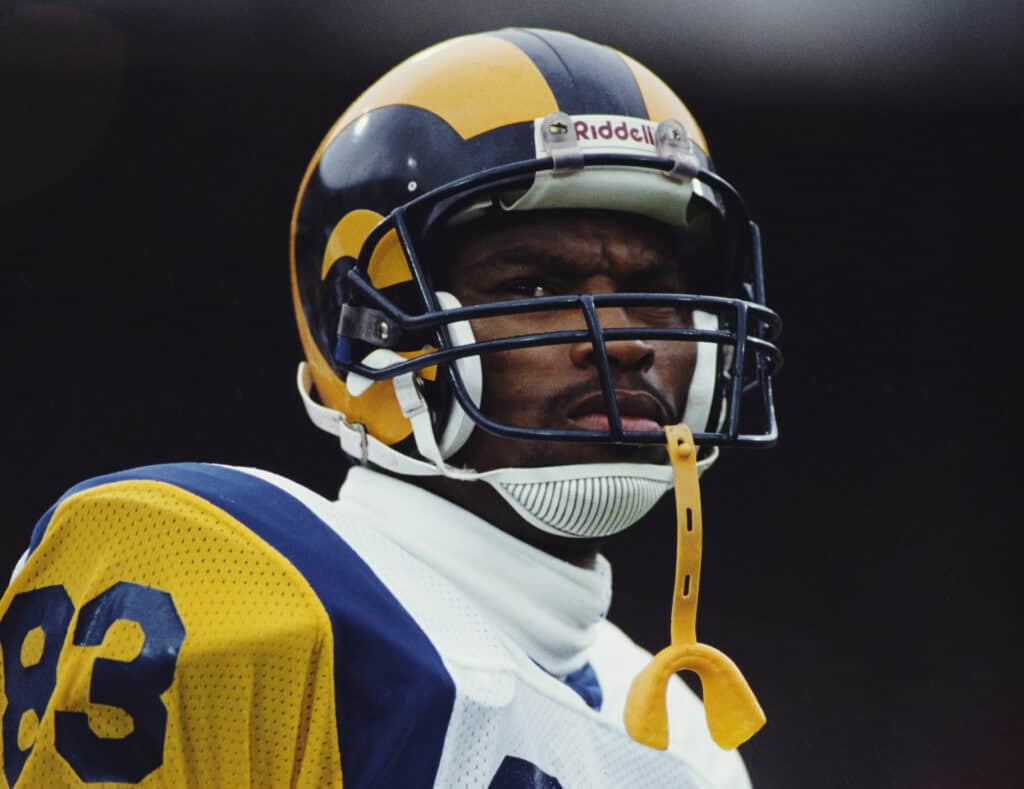
Although he is often overlooked, Ken Anderson is arguably one of the most successful quarterbacks in NFL history.
While playing 16 years for the Cincinnati Bengals, Anderson set numerous NFL and Super Bowl records.
He also owned the seventh-best career passing yards total in league history when he retired.
Unfortunately, Anderson had periods during his career where he was benched for poor play, suffered from nagging injuries, and ran for his life behind a leaky offensive line.
On the flip side, he was also the NFL’s MVP, Comeback Player of the Year and Offensive Player of the Year all in 1981, the league’s Man of the Year once, and led the NFL in three categories multiple times.
Is legendary Cincinnati Bengals QB Ken Anderson worthy of a National Football Hall of Fame induction? The Moeller Sports Analytics Class has the answer & more. WATCH: https://t.co/DobZyFqXEv #GoBigMoe #WhoDey pic.twitter.com/36dLhI1Wcw
— 𝗕𝗮𝗿𝗿𝗲𝘁𝘁 𝗖𝗼𝗵𝗲𝗻 (@BigMoBarrett) January 15, 2025
In fact, he is the only quarterback to lead the NFL in quarterback rating in back-to-back years in two different decades.
Additionally, Anderson led Cincinnati to its first Super Bowl.
Since his retirement, the former quarterback’s accomplishments have been lauded by football historians.
Yet, he has not been recognized by the Pro Football Hall of Fame selection committee.
Despite the perceived slight, Anderson turned his attention to work in radio before coaching in the NFL for almost two decades.
This is the story of Ken Anderson.
A Uniquely Talented High School in Batavia, Illinois
Kenneth Allan Anderson was born on February 15, 1949, in Batavia, Illinois.
Obviously, there must have been something special in the water in Batavia in the 1950s and 1960s.
That was especially true at the intersection of Harrison Street and Republic Road.
For several years, the Anderson home was nestled against the property of the Issel family.
Ken befriended neighbor Dan Issel at an early age and they have remained buddies ever since.
Another friend just down the road, Byron Von Hoff, played sports with Ken and Dan and the trio eventually became memorable in Batavia High School athletics lore.
Happy 74th birthday Dan Horse Issel. Fun fact: Craig Sager, Dan Issel and Ken Anderson were high school basketball teammates and Issel and Anderson were next door neighbors. pic.twitter.com/id2J1ln1Na
— Honest☘️Larry (@HonestLarry1) October 25, 2023
Anderson played football for the Bulldogs and also suited up for the hoops team with Issel, Von Hoff and another pal, Craig Sager.
Between 1965 and 1967, Batavia’s basketball team was hands-down one of the best in the state, and at one point, was undefeated in conference play.
Although they would go their separate ways after high school, the Batavia quartet would remain close.
As Anderson tried to find a college that would allow him to continue playing sports, Issel went to Kentucky to play basketball.
He would eventually play in the American Basketball Association (ABA) with the Kentucky Colonels and the NBA with the Denver Nuggets before induction in the National Basketball Hall of Fame in 1993.
Von Hoff also played baseball at Batavia and was chosen by the New York Mets in the 1966 Amateur Draft.
After a few seasons of minor league ball as a pitcher, Von Hoff sustained an injury and had to retire.
On the anniversary of his passing, we honor the memory of Craig Sager.
We remember his passion for life today; as we do our best to live full of life, full of fun, and full of style!
We will forever be #SagerStrong! pic.twitter.com/S7IFjJqRdN
— NBA Cares (@nbacares) December 15, 2024
Sager attended Northwestern University in Illinois and later became an award-winning broadcaster for a number of high-profile television stations.
The popular NBA sideline reporter, who was also well known for his unique fashion sense, passed away in 2016 at age 65 from leukemia.
“What Batavia instilled in all three of us—myself, Kenny and Craig—was a solid work ethic. I hope the people of Batavia appreciate how much Batavia meant to Craig and all of us because we appreciate what Batavia did for us,” said Issel years later.
Augustana College
Anderson and friends had a formidable basketball team at Batavia, but his athletic ability didn’t quite translate to college interest.
While Issel, Von Hoff and Sager were all preparing for their next significant step on the road to maturity, Anderson mailed out a lifeline.
He decided to write to Ralph Starenko, the head football coach at tiny Augustana College in Rock Island, Illinois.
Anderson humbly asked Starenko if he could try out for the Vikings’ football team and possibly play for the basketball team as well.
Since Starenko didn’t have blood-sucking boosters to appease or have to worry about copious national titles, he agreed to take a look at Anderson.
When the lanky, 6-2”, 200-ish-pound quarterback arrived in 1967, he made the team and saw just enough action to set a new program record with 12 touchdown passes.
In 1968, he was thrust into the starting spot full-time and he shined.
Batavia, IL native and Augustana College alumni Ken Anderson won the 1981 NFL MVP. He’s the only person from Illinois to win the award. pic.twitter.com/3pLlY6QCUz
— Dan H (@WindyCityCritic) May 8, 2019
Although the Vikings regressed from 4-5 to 2-7, Anderson set several Vikings single-season records.
They included 136 pass completions, 2,117 passing yards, 20 passing touchdowns (breaking his own record), and a 235.2 passing yards per game average.
Displaying the range of his athleticism, Anderson also kicked extra points and field goals.
His totals brought the sophomore recognition as an AP honorable mention All-American.
All of his marks have since been surpassed, but Anderson is still in the top two or top ten in all major categories in program history.
Two-Sport Star
In 1969, Augustana and Anderson slightly improved to 3-6.
Following each of his first three years in college, Anderson went from the gridiron to the hardwood to play for the Augustana basketball team.
During his career, he scored 1,044 points and lettered all three seasons.
Anderson didn’t play hoops during his senior year so he could focus on football, where he envisioned a possible future in the pro ranks.
We’re 1️⃣ week away from 🏈! Here’s a look at our Ken Anderson Academic All-American Club & facilities. Augie is currently 3rd in DIII & 7th across all of NCAA in total Academic All-America Selections. #theAUGIEway pic.twitter.com/TuzgdkxRCu
— Augustana Football (@AugieILfootball) August 6, 2019
Then, in 1970, Anderson led the Vikings to a 4-6 record and received the College Conference of Illinois and Wisconsin (CCIW) MVP award and was selected as an Academic All-American.
Additionally, he was named the Vikings’ Most Inspirational Player.
He ended his college career as a four-time letterman in football and fifth all-time in NCAA history with 6,679 yards in total offensive yardage.
The pride of Augustana, Ken Anderson!! @Bengals @AugieILfootball @Augiehoops @augiesid https://t.co/8K4fIxPSrE pic.twitter.com/JpqwkNmlzY
— Matthew Nicol (@MatthewNicol82) May 15, 2020
Anderson was chosen to participate in the North-South Shrine Game after his senior year.
In 2003, the former Vikings’ all-time record holder was added to the Augustana Hall of Fame.
The Cincinnati Bengals Quarterback Issue

In their short history, the Cincinnati Bengals were always on the lookout for players who were not only athletic but also had a sharp mind.
The organization’s head coach, Paul Brown, had arrived in Cincinnati in 1968 after founding and leading the Cleveland Browns for their entire existence.
Happy birthday to Paul Brown, the man who started it all 🐅 pic.twitter.com/q9QQmGMvVE
— Cincinnati Bengals (@Bengals) September 7, 2024
After the Bengals went 3-11 in its inaugural season, Brown selected quarterback Greg Cook from nearby University of Cincinnati in the first round of the 1969 draft.
The rookie had a howitzer for an arm and the moxy between the ears that Brown loved.
Shortly after leading Cincy to a 3-0 start, Cook felt a pop in his throwing shoulder but continued to play through the pain.
Paul Brown
Greg Cook#Bengals pic.twitter.com/7eKtTpEued— Old Time Football 🏈 (@Ol_TimeFootball) November 24, 2021
He led the Bengals to unexpected victories over the Oakland Raiders and Kansas City Chiefs during the year.
Although a 4-4 start led to a 4-9-1 season, the coaching staff was all-in on Cook, who was named the NFL’s Offensive Rookie of the Year.
“He broke the mold. He could just do everything,” Paul Brown’s son, Mike Brown, said about Cook years later. “He just found people. He could find receivers better than anybody I’ve ever known. He could find them in all ranges. In my mind he was the best talent we’ve ever had here before he got hurt.”
As it turned out, the pop Cook experienced turned out to be a torn rotator cuff and his biceps muscle had been partially detached.
Sadly, he would never return to form, and in 1970, Cincy turned to Virgil Carter, who helped receivers coach Bill Walsh run an early version of the West Coast offense.
Carter’s play resulted in an 8-6 record and playoff berth, one of the few expansion teams in any professional sport that reached the postseason by its third season.
While the Bengals lost to the mighty Baltimore Colts in the divisional round, Brown and Walsh were already eyeing their next quarterback.
Walsh and the Browns like Anderson
Although Brown and Walsh liked Carter’s literal mathematical mind, they knew that he ultimately wouldn’t be the answer for the team long term.
Brown was an early pioneer in scouting college talent and sent his sons, Mike and Pete, into the hinterlands to find players.
“Except in rare instances. Nobody sent the film to you. You had to go there,” Mike Brown said in 2015. “They’d set up the projector for you. They were glad to see you. You weren’t seen as a nuisance or getting in the way. They were flattered there was an NFL team that was interested.”
One such prospect was Augustana’s Ken Anderson.
Mike Brown watched Anderson play during his senior year against Wheaton College and came away impressed.
“Quick feet. Excellent coordination. Can throw on move. Would be effective on broken plays. His accuracy is very good,” Brown wrote of the Wheaton game. “He is more accurate than (Greg) Landry or (Roman) Gabriel at this stage and moves better than both. He throws different speeds, not just one as Gabriel did in college. He is not as strong as Gabriel. More like (Daryle) Lamonica for size and speed on ball.”
Brown took note of the serious lack of competition Anderson faced but thought he had the intangibles that the Bengals needed.
“Anderson has never been hit hard or seen coverages,” continued Brown. “Only the actual test would prove how he could handle these things. If he handles them up to his potential physically, he would be the equal of Lamonica or better. Physically, Anderson has the potential to be a star NFL QB. He will need a long time to develop because of a lack of background. I would take him in the second round if he is available.”
Pete Brown agreed with his brother.
In his scouting notebook, Brown had a heading called, “What Do We Need To Know Further for Final Rating On This Prospect.”
For Anderson, he wrote, “Just take him.”
The next person to watch Anderson was Walsh who also liked the quarterback’s smarts and feel for the position.
“Appears to be excellent prospect equal to – or better than (Dennis) Shaw, (Mike) Phipps, (Don) Horn,” Walsh said. “1. good size – strong built good legs – will be 6’2 -210; 2. Good movement, quick on feet, good balance; 3. Fine throwing arm, accurate – good at any distance; 4. Quick delivery- can throw instantly- off balance; 5. Instincts – finds receiver – can get ball to him late; 6. Poised – doesn’t become rattled- good leader; 7. plays when hurt – hip injured in 1st qtr continued; 8. appears tough enough – went after fumble,” Walsh wrote in his scouting report.
Mike and Pete Brown, along with Walsh, felt that Anderson could go as high as the first round, but was definitely a second-round prospect.
Paul Brown, however, had the final say on personnel matters and took a pair of offensive linemen in the first and second rounds.
Paul Brown Feature 1975#Bengals pic.twitter.com/n1kpeJMm0N
— Old Time Football 🏈 (@Ol_TimeFootball) November 2, 2023
Before the third round began, Mike Brown leaned over to his dad and said, “He [Anderson] would be a good buy here.”
With the 67th overall pick in the third round, Cincy selected Anderson.
Becoming the Starter
Anderson began his rookie year on the sideline while learning the pro game from Paul Brown and Walsh.
He started four times during the Bengals’ 4-10 season but lost every game, ending his 1971 season with 777 passing yards, five touchdowns and four picks.
October 10, 1971
Ken Anderson's first NFL start#Bengals PFHOFer Paul Brown and #Dolphins future-PFHOFer Don Shula square off for the first time in the regular season as head coaches.
Brown had drafted Shula to play for the Cleveland Browns 20 years earlier. pic.twitter.com/CQyU2gupPB
— Kevin Gallagher (@KevG163) October 10, 2024
In 1972, he supplanted Carter to become the team’s starter and responded with 1,918 yards, seven touchdowns and seven interceptions.
The Bengals improved to 8-6 and looked like a team on the rise.
Then, in 1973, Anderson passed for 2,428 yards, 15 touchdowns and 12 picks and Cincy went 10-4 before losing to the Miami Dolphins in the playoffs.
The #Bengals Ken Anderson strikes twice to super rookie Issac Curtis, Week 14 1973. Check the wheels on 85.
A lethal tandem during the 1970s pic.twitter.com/G7S9PbB7w7
— Kevin Gallagher (@KevG163) March 3, 2022
During the game against the eventual Super Bowl winners, Anderson struggled and completed just 14 of his 27 passes for 113 yards and an interception.
Coming into his Own
Throughout his first few years in the NFL, Walsh and Anderson were joined at the hip and the bright coach tutored the heady quarterback on the intricacies of the West Coast offense.
A solid 1973 season morphed into a fantastic 1974 for Anderson.
Cincy regressed to 7-7, but the quarterback was first in the league in several categories including passing yards (2,667), completion percentage (64.9), and passer rating (95.7).
Ken Anderson #Bengals pic.twitter.com/8qFw6IGgtr
— Old Time Football 🏈 (@Ol_TimeFootball) June 13, 2023
He also had 18 touchdowns and 10 interceptions.
1975 brought more of the same.
Anderson was on fire while leading the Bengals to an 11-3 record and leading the NFL in six categories.
Among them were passing yards (3,169) and passer rating (93.9) along with 21 touchdowns and 11 interceptions.
“Precision passing. I mean, the most accurate I’ve ever seen. He could put it in the tightest spots, the tightest spots every time. Beautiful mechanics. Just extremely intelligent. Attention to detail, an accounting-type personality, a computer-like mind,” said former teammate Dave Lapham.
At long last, Anderson’s peers recognized his play and he was chosen for his first Pro Bowl and named a second-team All-Pro.
2 days until we start our 50th Season at HOME. #BALvsCIN
Number 2 on the #Bengals First 50: Ken Anderson#Bengals50 pic.twitter.com/gnhJcTwq49
— Cincinnati Bengals (@Bengals) September 8, 2017
His philanthropic work also brought Anderson the NFL’s Man of the Year award.
During the ‘75 season, Anderson pummeled the Buffalo Bills in Week 9 while passing for a team-record 447 yards and adding another franchise-best 553 total offensive yards.
The victory was Cincy’s first-ever win on Monday Night Football.
In the divisional round, Anderson played well against the Raiders, throwing for 201 yards and two scores, but his line gave up five sacks and Oakland prevailed, 31-28.
A Few Bumps in the Road
Following the 1975 season, Paul Brown retired from coaching and Walsh departed to become the offensive coordinator for the San Diego Chargers.
New head coach Bill Johnson led his troops to a 10-4 record but didn’t qualify for the playoffs.
Anderson, despite not having his two mentors for the first time in his career, still passed for 2,367 yards, 19 touchdowns, and 14 interceptions, bringing him Pro Bowl number two.
Ken Anderson#Bengals pic.twitter.com/qK01wbB7mA
— Old Time Football 🏈 (@Ol_TimeFootball) February 3, 2021
In 1977 and 1978, the Bengals went 8-6 and 4-12 respectively and Anderson passed for over 2,000 yards both years.
However, he missed the first four contests in 1978 with a broken hand and had an ugly final stat line of 10 touchdowns against a whopping 22 interceptions.
In 1979, Homer Rice’s only full season as the head coach brought another 4-12 record as Anderson improved to 2,340 yards, 16 touchdowns and 10 picks.
A New Regime, A “New” Anderson
As the 1980s dawned in Ohio, the Bengals started over with a new head coach, former Green Bay Packers great, Forrest Gregg.
Gregg, like Paul Brown before him, had been the head coach for the Cleveland Browns and delivered an 18-23 record in three seasons (1975-1977).
He wasn’t about to suffer another losing streak as a team leader.
“We went into training camp that ‘81 season, and by the third practice, Forrest Gregg had us running Oklahoma drills,” Anderson said in 2022. “Throughout the season, we’d focus on short-yardage situations on Friday. Aside from trying to go out and physically hurt your teammates, we had full contact in those practices. He put us through the wringer in a time where that wasn’t uncommon, but it brought us closer together and made us stronger as a unit.”
Cincinnati improved by two victories under their new coach, but Anderson was just 5-7 as the starter and had under 2,000 passing yards for the first time since 1972.
Ken Anderson #Bengals pic.twitter.com/WW8sPVDhjr
— Old Time Football 🏈 (@Ol_TimeFootball) September 3, 2022
Furthermore, he had a woeful six touchdowns and 13 interceptions, leading some in the media to believe the quarterback’s best days were behind him.
Things got even worse in Week 1 of the 1981 season when Cincy found itself losing to the Seattle Seahawks, leading to Gregg’s decision to bench Anderson.
Backup Turk Schonert was inserted and promptly led the Bengals to a come-from-behind 27-21 win.
“We started the season against the Seahawks, and I threw three interceptions in the first quarter and got benched,” Anderson recalled with a laugh. “My backup was Turk Schonert. Luckily he came in and played pretty well and we won. Somehow, I talked myself into starting the next week against the Jets, and we started rolling from there.”
When cooler heads prevailed, Gregg decided to keep Anderson as his starter and both quarterback and franchise reached unprecedented heights.
Ken Anderson never had the luxury of a balanced running game. He never played with a 1,000 yard rusher or Pro Bowl running back in his career until 1981 (Pete Johnson). The result that year was @KenAndersonNFL becoming @NFL MVP and the #Bengals first Super Bowl. #BengalsHOF pic.twitter.com/K5tc2whKcR
— Bengals HOF (@BengalsHof) February 20, 2021
A 5-3 start became an eventual franchise-best 12-4 record that included huge wins and Anderson connected often with rookie receiver Cris Collinsworth.
“It didn’t start very well for me,” Anderson said of that season. “I think we had five games in November all against playoff contenders and not one of them was a close game. All of a sudden it was, ‘We are for real.'”
Bengals offensive coordinator Lindy Infante helped unleash Anderson on the way to a career-high 3,754 yards, 29 touchdowns and 10 interceptions.
He led the NFL with a 98.4 passer rating, was voted to his third Pro Bowl, and selected for his only career first-team All-Pro nod.
The NFL recognized Anderson as its Comeback Player of the Year, league MVP and Offensive MVP.
“We did a lot of option routes where the receivers had a lot of different things,” Anderson said. “In ’80, at the end of the year we were getting better and, of course it, all clicked in ’81. We were kind of one of the first ones to do the quarterback bootlegs. The out-of-pockets. The nakeds. Whatever you want to call them. We had a lot of success with it. Lindy was an innovator.”
Super Bowl XVI
In the divisional round, Anderson passed for 192 yards and a score as the Bengals won its first-ever playoff game, 28-21, against Buffalo.
A week later, San Diego and quarterback Dan Fouts were no match for Cincy in the aptly named “Freezer Bowl” (a wind chill of -59 degrees).
“We had guys in the locker room trying to figure out what to wear because no one had ever played in anything like that,” Anderson recalled. “We didn’t have hand warmers in those days, and the gloves weren’t doing the trick so there were a couple guys who took their leather gloves that they wore to the stadium and they threw some tape over them because it kept their hands warmer than the other gloves did.”
Anderson and his teammates were in their element and 161 yards, two touchdowns and a 115.9 passer rating led to a rather easy 27-7 win.
Next up was a Super Bowl XVI match-up against the San Francisco 49ers and quarterback Joe Montana.
1982 NFL SuperPro Club commercial, featuring the starting quarterbacks from Super Bowl XVI, played 43 years ago today
The #49ers' Joe Montana and the #Bengals' Ken Anderson pic.twitter.com/TiMflPJRIo
— Kevin Gallagher (@KevG163) January 24, 2025
San Fran was led by Walsh, who was in his third year with the organization.
“No one expected us to be there, but no one expected the 49ers to be there, either,” Anderson said. “We were both 6-10 the year before, so not many people thought either team would make it all the way. Bill and I had remained friends throughout that time, and we would see each other every day at the Pontiac Silverdome because they would be leaving practice as we showed up for our practice. We knew each other well from our time together, and I think that helped with how he got them prepared for the game.”
In the first half, Walsh clearly had the goods on his former pupil as Montana and company built a 20-0 lead.
The second half would be a different story altogether.
Anderson ran for a five-yard score in the third quarter and connected with tight end Dan Ross on a pair of touchdown throws in the fourth.
1981 became a breakout year for both #FTTB & #RuleTheJungle. Both teams met in Super Bowl XVI. Ken Anderson was the NFL's MVP that season & Joe Montana the Super Bowl MVP. The teams also played in Week 14 that season in Cincy with San Fran. winning the Super Bowl preview 21-3. 🏈 pic.twitter.com/wmOy44aDvp
— Ken Gelman (@kengfunk) October 29, 2023
San Francisco kicker Ray Wersching kept pace with two field goals in the final quarter.
Despite the Bengals’ furious rally, the team came up short, losing 26-21.
Had Cincy won the contest, it was fairly evident that Anderson would have been named the MVP based on his 300 passing yards and three combined touchdowns.
His number of completions (25) and completion percentage (73.5) during the game set Super Bowl records at the time.
Instead, the award went to Montana.
“He played the most important position and he played it well,” Mike Brown said in 2015. “We were competitive with anybody when he was going at his peak. I remember the Super Bowl game with him at quarterback up in Detroit. To this day I think we were the better team. We just didn’t win. He played well.”
Still Slinging It
In 1982, the NFL players went on strike, shortening the season to nine games and reshaping the league’s playoff structure.
Anderson was a Pro Bowler for the fourth time with 2,495 yards, 12 touchdowns and nine interceptions.
He also led the NFL with a 70.6 completion percentage and 95.3 passer rating.
The latter stat made Anderson the only quarterback in NFL history to lead the league in passer rating in back-to-back years in two different decades (1974-75 and 1981-82).
His lofty completion percentage wouldn’t be broken until 2011 when the New Orleans Saints Drew Brees surpassed him with a 71.2 percentage.
Cincy went 7-2 in 1982 before falling to the New York Jets, 44-17, in the First Round.
40 Years Ago Tonight
October 10, 1983#Steelers defensive end Keith Gary infamously and viciously rips #Bengals quarterback Ken Anderson to the ground by the facemask in the first quarter of a 24-14 Pittsburgh win at Riverfront on Monday Night Football.The gritty Anderson… pic.twitter.com/5WibeqGwUL
— Kevin Gallagher (@KevG163) October 10, 2023
A year later, Anderson passed for over 2,300 yards and led the league with a 66.7 completion percentage.
The Bengals, though, could only get seven wins and Gregg left the team to lead the Packers.
Anderson Retires

With Gregg’s departure, the Bengals hired former player, Sam Wyche, in 1984.
Anderson was still the starter, but Wyche and the front office knew that it was only a matter of time before they had to replace their leader.
With the 38th overall selection in the second round, Cincy took Maryland signal-caller Boomer Esiason.
#Bengals draft picks Pete Koch and Boomer Esiason arrive at airport after NFL Draft 1984. pic.twitter.com/7det0uGeTC
— Cam Miller 🎥 (@cammillerfilms) April 28, 2023
Esiason was given playing time after Anderson could do no better than 3-6 as the starter.
The rookie QB displayed his talent with a 3-1 record as the main man under center and Wyche was sold.
Anderson could have retired before 1985, but he told the media he wasn’t finished.
“I don’t have it out of my system yet,” Anderson, 36, said of his career. “I think I can still play.”
Mike Brown, then the team’s general manager, was also optimistic of Anderson’s ability.
“I see more than one scenario with Ken Anderson,” Brown said. “One is that he would start and we would get off and running and he would lead us the whole way. The other scenarios would be less than that.”
That optimism didn’t last long.
For the next two seasons, Anderson was stuck on the bench as Esiason thrived.
In 1985 and 1986, Anderson had a combined two starts, 341 passing yards, three touchdowns and two interceptions.
When the ‘86 season concluded, he retired.
Bengals QB Ken Anderson led the NFL in passing twice with the Bengals. He also led the league in passer rating four times and completion percentage three times. 1981, Anderson won the NFL MVP award and led the Cincinnati to their first Super Bowl. He also won the NFL OPOTY. pic.twitter.com/bNixhKkT6f
— Randall Potts ✌️ ☮️ (@eyeamRandy) February 8, 2025
During his 16 seasons with the Bengals, Anderson passed for 32,838 yards (seventh all-time when he retired), 197 touchdowns and 160 interceptions.
Additionally, he added 2,220 rushing yards and 20 rushing touchdowns.
Anderson was a four-time Pro Bowler, two-time All-Pro, NFL MVP, Comeback Player of the Year, Offensive Player of the Year, Man of the Year and led the league in passing yards twice, completion percentage three times and passer rating four times.
Since retiring, the former quarterback has been named to the Bengals’ 50th Anniversary Team and added to the Cincy Ring of Honor.
Coaching and a HoF Snub

Shortly after calling it quits, Anderson worked in radio and called Bengals games from 1987 through the 1992 season.
Beginning in 1993, he returned to the sidelines as a coach for the Bengals and spent time as the organization’s quarterbacks coach and offensive coordinator.
In 2003, Anderson moved to Jacksonville to work with the Jaguars’ receivers and quarterbacks through 2006.
Early in 2007, Pittsburgh Steelers head coach Mike Tomlin hired Anderson to work with his quarterbacks.
Happy Birthday to Former #Steelers
QB Coach Ken Anderson
" Joe Greene and Lynn Swann walked up to us, and Joe congratulated me and told me I finally got my Super Bowl ring – I just had to come to Pittsburgh to get it!"https://t.co/VtBpkptm3vOT Marcus Gilbert pic.twitter.com/57kRc8kjTG
— Steelers Takeaways 🌗 (@PittsburghSport) February 15, 2023
Anderson remained in the position through 2009 and won a world title as a coach when Pittsburgh beat Arizona in Super Bowl XLIII.
That would be the final season of Anderson’s coaching career.
As he was mentoring young NFL pros, the Pro Football Hall of Fame selection committee continually snubbed Anderson for induction.
BREAKING: Bengals legend QB Ken Anderson will MISS out on the Pro Football Hall of Fame AGAIN aftering not making the final vote.
Anderson, the 1981 NFL MVP is the Bengals all time leader in passing yards and 2nd in passing TDs.
It is past time for Anderson to be recognized. pic.twitter.com/KfxcgMg7wu
— Bengalscentre (@benga1scentre) December 3, 2024
Despite the fact that he put up great numbers, Anderson is still overlooked by Hall voters.
Numerous writers have pointed out that Anderson’s career stats are better than several players already inducted into the HoF.
For example, he led the NFL four times in passer rating.
The only other quarterback to best him is Steve Young, inducted in 2005.
Pro football scribes have also noted that a number of HoF inductees have never appeared in the Super Bowl.
Anderson lost one as a player but won one as a coach.
From 2022- 2024, he made the HoF senior semi-final list but was not voted in.
Still hoping for his name to be added to the pantheon of pro football immortals, Anderson, 76, currently spends his days working with adults with disabilities and started the Ken Anderson Foundation (renamed “Alliance”) in 2011.
References
https://athletics.augustana.edu
https://archive.ph/20110514144312/http://www.coldhardfootballfacts.com
https://web.archive.org/web/20100120114840/http://www.steelers.com/article/116731/
https://fansided.com/2022/01/27/bengals-ken-anderson-similarities-1981-2021-teams/
https://bataviahistory.org/wp-content/uploads/2019/08/homecoming-celebration-2015-1.pdf
https://vault.si.com/vault/1982/01/25/walshs-boys-go-head-to-head
https://talkoffametwo.com/nfl/state-your-case-ken-anderson
https://cciw.org/news/2020/9/23/football-cciw-legacy-series-ken-anderson-augustana-college.aspx
https://www.lineups.com/articles/looking-back-at-cincinnati-bengals-legend-ken-anderson/
https://talkoffametwo.com/state-your-case/state-your-case-ken-anderson
https://athletics.augustana.edu/honors/tribe-of-vikings-hall-of-fame/ken-anderson/59
https://www.bengals.com/news/another-close-hall-of-fame-miss-for-bengals-great-ken-anderson
https://www.bengals.com/team/ring-of-honor/kenanderson
https://www.pro-football-reference.com/players/A/AndeKe00.htm
NEXT: The Life And Career Of Jon Kitna